How to Start Birding

Hooded Warbler in Central Park (April 2020)

Birds mostly are small and difficult to see well with only the unaided eye. A pair of binoculars is essential for birding. The good news is that this likely will be the only thing you have to buy, and the cost need not be high.

You might also want some knowledge about the birds you will observe and about how to observe them.

Buying Binoculars

We recommend using binoculars with eight, ten, or (maybe) twelve magnification and an objective lens diameter between 30 and 50 mm. Binoculars usually are specified by these two numbers, for example as being 8×40.

The larger the objective lens diameter, the more light in your view, and the larger your field of view. More magnification narrows your field of view but makes things look larger.

Our personal preference is 10×42, as the field of view is still large and more details are visible, particularly when birds are distant. Now that binoculars are made of lightweight materials and streamlined construction, the weight difference is negligible between these and smaller ones.

Binoculars with 12x magnification have grown in popularity and users seems pleased with them. For looking at still, perching birds they should be fine, but they will make it harder to stay focused on birds that move often, like warblers, or on birds in flight.

We also appreciate having close focus ability, that is, being able to focus on birds nearby, which some binoculars cannot do. How close? Our binoculars can still focus at eight feet, but if you can get twelve feet or better you probably will be pleased. Sometimes birds land nearby and give amazing views, and you don’t want to miss those.

We don’t recommend so-called “compact” binoculars for birding, though some birders carry these around in a handbag for unexpected bird encounters when doing other things.

Read more about choosing and understanding binoculars here.

Advances in manufacturing have made good binoculars affordably priced. This used to not be the case, and older online guides recommend spending much more than is necessary today.

We think that adequate binoculars can be had online for $50 or so, likely similar in quality to what we used in our first few years of birding. These Gosky 10×42 binoculars are $65 after you apply the coupon, for example.

If you spend more, you can get sharper views: better construction, better glass, better coatings.

These Vortex Diamondback HD binoculars ($229) are excellent in all regards and come with a lifetime warranty against any damage, even if the damage was your fault. They are similar in quality to what we use now.

Shop around. There are many manufacturers and choices. The mentions above are simply examples, and we do not receive any payment or consideration for them.

Birding Knowledge

Once you have binoculars, you are going to want to go birding. You will find that you can bird almost anywhere, that birds are around us even in the middle of urban areas like Manhattan, where we do our birding.

Of course, you will find a greater variety of birds in parks and on and along bodies of water.

How you go about birding is up to you. If you are more social, you might want to go with some friends, perhaps with some who already know a bit about birding.

We liked going to the park and experiencing nature on our own. It’s up to you.

We started by simply observing birds, looking and listening, and then trying to figure out what they were. This deductive process can be a lot of fun. We would remember the details of the bird, saving its image in our mind, and then check online and in a guide book to try to match what we observed to a species.

Now the process is even easier, and you can do it in the field thanks to the excellent and free Merlin Birding app.
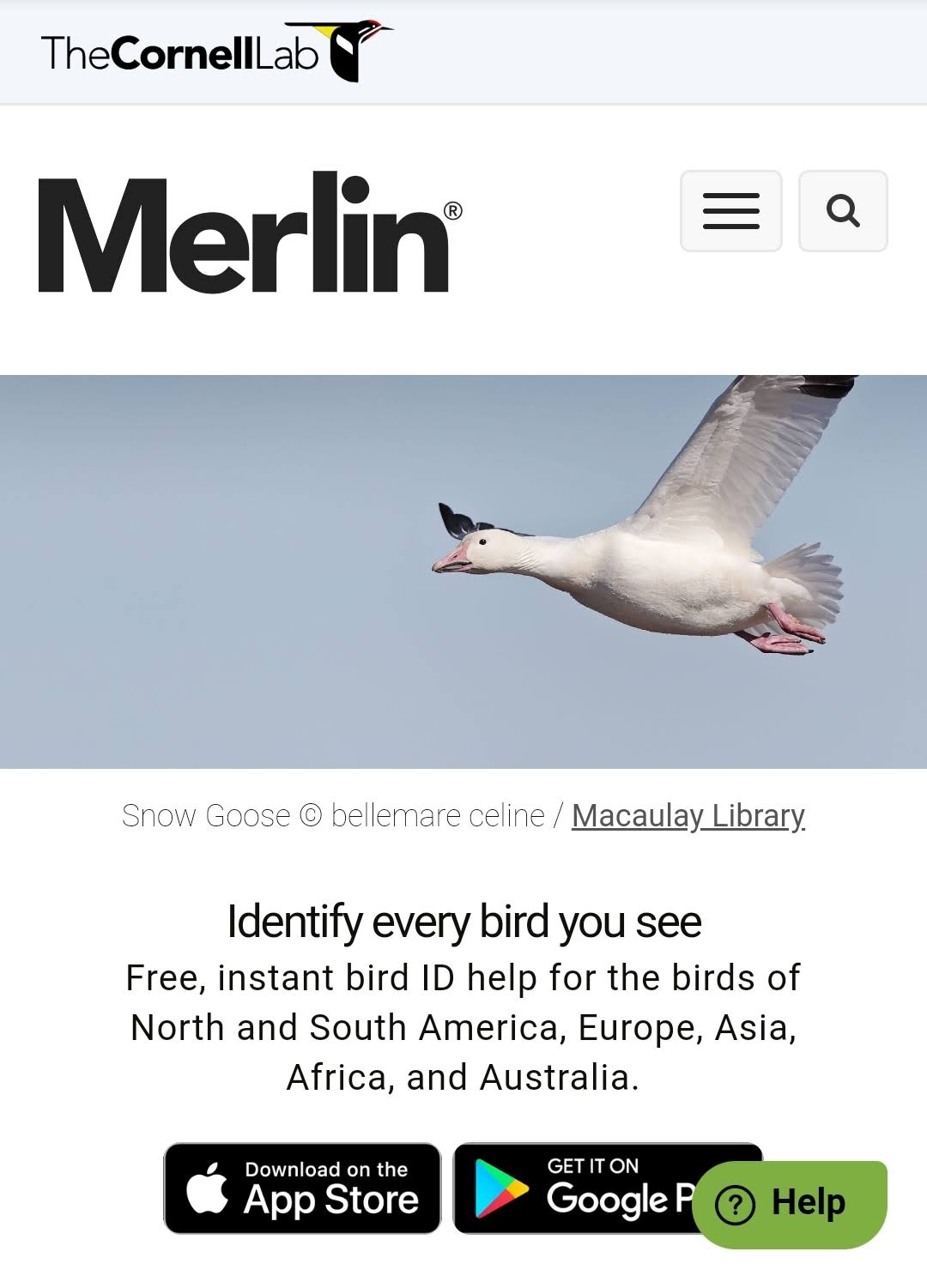
Once you have downloaded this app to your smartphone, it will suggest birding packs of photos and sounds to further download. Download the pack relevant to where you live. For example, we use the US: Northeast pack.

Now you can set up one of the most useful features of Merlin: you can have it display the birds you are likely to encounter in your area in approximate order of their abundance.

Go to the menu at the top, right-hand side and choose “likely birds.” Further select for current location (which the app will suggest), Today, and sort by “Most likely.”
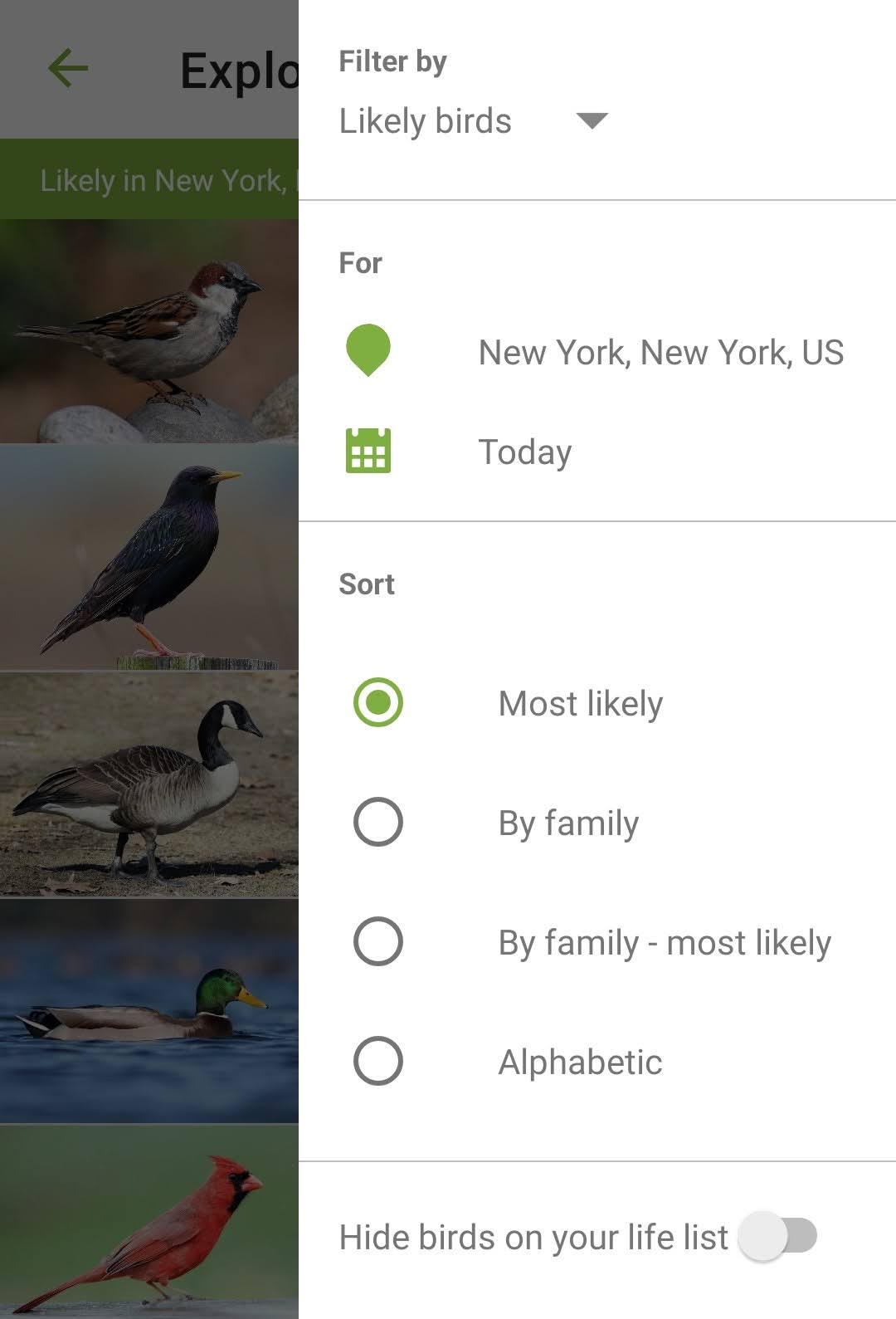
Now the app should display something like this:

The bar graph displayed shows relative abundance of the species in your area during different times of the year.

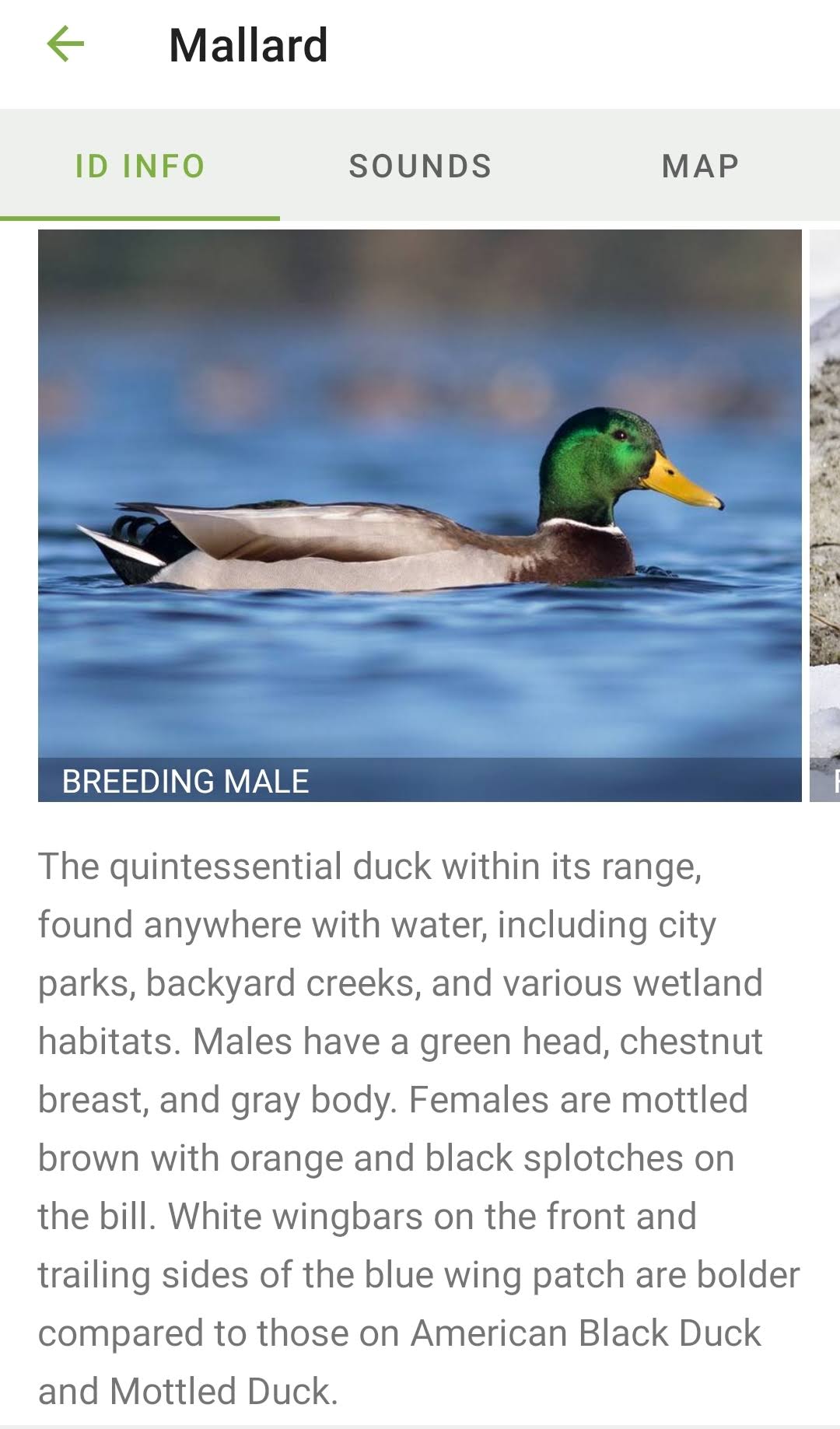
These are indeed the most common birds in our area. You can go right down the line and learn a bit more about them, including more photos (which are useful because often male and female birds look different and appearance may vary depending on the time of year).

For example, the Mallard:
We suggest quickly reviewing the fifteen to thirty most common birds in your area before you go birding. You can then enjoy the thrill of recognition, and you will have an idea of what to expect.

The most prevalent beginner-birder mistake is thinking that some common bird is actually some other rare bird. By using the “likely” sort in Merlin, and focusing first on learning the most common birds, you can do much to avoid this error.

The Merlin App also has a powerful bird-photo identification tool driven by AI. With good photos, we find that it is almost always right (90+%) in suggesting the most likely species. The app also can identify your birds by asking you questions.

When you want to learn more about a bird species—what habitats if prefers, what it eats, how and where it breeds, etc.—visit Cornell’s AllAboutBirds website, which has a wealth of information not only on each species but on birds in general.

In particular, we recommend the Bird ID Skills section of this site, which has excellent instruction on how to become better at birding.

Once you can reliably identify most of the birds you encounter, consider making a free account on eBird and using it to track what you observe and find out what others are reporting.

We run Manhattan Bird Alert on Twitter. Our daily posts of alerts, photos, videos, and commentary have helped many to learn birding or to enjoy it more. Check it out!

Now is a good time to begin your learning, starting with the common birds. By the end of May over 90 new bird species will have passed through Manhattan in addition to those already observed this year. The arrival pace stays fairly manageable through mid-April and then a torrent of birds arrives in early May.

Best to you on your birding!

Sandhill Crane, Inwood Hill Park

Sandhill Cranes have a southern breeding range not too far north of Manhattan, in upstate New York, Connecticut, and Massachusetts. They frequently stopover in nearby Somerset, New Jersey, during migration. They breed in wetlands, and they will touch down in those or in expansive grasslands. They are not likely ever to land in Manhattan, and they are known to fly very high when migrating, which explains why they are so rarely observed here despite having a nearby presence and being large, unmistakable birds.

It never occurred to me that they even were a possibility until a birder reported one flying over the Bronx Zoo in May 2016. A report of seven Sandhill Cranes flying over Fort Tryon Park in Manhattan followed in December 2016. Then three more were seen over Fort Tryon in January 2017 by the same observer. It’s likely that another two were seen from midtown over the Hudson in December 2017.

These observations stoked my interest, but I saw no practical way to get the birds. Sandhill Crane appearances were not part of a daily movement pattern — they were notably infrequent. Plenty of birders were reporting from the Inwood area most days and not seeing any cranes. A dedicated Sandhill Crane watch of any length would almost certainly produce none. Still, it was a species to keep in mind.

Yesterday, 16 October, I went to Inwood Hill Park to do some sky-watching and river-watching. It was a decent, sunny morning with moderate northwest winds, and I was seeing some Bald Eagles floating overhead. Brant flocks were moving low down the Hudson.

At 11:48 a.m. I saw high-flying bird over Inwood Hill with just my eye and I focused my binoculars on it. It clearly was not a goose or a raptor. It had long, broad wings beating slower than a goose’s would, a long, outstretched neck, and feet trailing outstretched behind it. As it turned into sunlight, I noticed grey wings and body, and briefly a pale cheek patch and darker crown — a Sandhill Crane, flying southwest over the Hudson.

With only three other birders on record as having observed a Sandhill Crane in Manhattan in three other occurrences, the species must be considered among the rarest few I have had here. The North American population appears to be continuing a multi-decade trend of population increase, so perhaps it will appear here more frequently in the future.

August Rarities in Central Park

After warning Manhattan birders from my @BirdCentralPark Twitter feed that Thursday-night radar was lighting up and that the morning could bring some good birds, I planned on looking for shorebirds in Inwood. I had already observed nearly every bird likely to occur in Central Park in the spring.

Those plans changed quickly, on Friday, 10 August 2018, when Robert DeCandido sent a 7:56 a.m. alert of Orange-crowned Warbler in the Central Park Wildflower Meadow, a species I still needed for the year. (As did nearly everyone else. Unlike 2017, when Orange-crowned Warbler was seen often during spring migration, 2018 brought perhaps only one such bird, seen on only one day.)

As I was getting ready to run to the North End, DeCandido found and reported another rarity: Yellow-breasted Chat southwest of the A. H. Green Bench, near the Wildflower Meadow.

The temperature was rising quickly (it would reach 86 F later) and it was a sunny day, so I knew that bird activity would soon decline. I ran to the Wildflower Meadow and looked around.

I did not see or hear any migrants, so I went to check the Green Bench area, which also had no birds of interest.

I knew that the species I was seeking almost surely were still in the area, whose dense foliage offered excellent habitat. I also knew that DeCandido and his birding group would be coming by soon, so I continued looking.

Half an hour later DeCandido and group arrived. Having Robert DeCandido around is a tremendous advantage, because DeCandido is a master of using sound to attract birds.

I have birded with him extensively, and I can relate dozens of times when no migrant activity was evident, yet after DeCandido played appropriate calls for a minute or two, warblers, vireos, and flycatchers would appear in nearby trees.

Such was the case again. We began seeing expected migrants like Canada Warbler, American Redstart, and Yellow Warbler. We even had an early Black-throated Blue Warbler.

Then DeCandido spotted the Yellow-breasted Chat again, in a fruiting tree on the northwest side of Wildflower Meadow, and everyone had great views of the perching bird.

Then we moved to the southwest corner of Wildflower Meadow, and the sounds DeCandido played drew in warblers to trees that had been empty before our arrival. We had Red-eyed Vireo, another Canada Warbler, an empidonax flycatcher, and a couple American Goldfinches.

After much waiting we noticed some rustling low in the brush, and DeCandido soon had everyone on a handsome Orange-crowned Warbler.

DeCandido’s observations of Yellow-breasted Chat and Orange-crowned Warbler set the earliest-ever records for fall migration for these species, the latter by over a month. A most remarkable morning in Central Park!

Boat-tailed Grackle, Central Park

Female Boat-tailed Grackle (credit: AllAboutBirds.org)

As I have written before, Boat-tailed Grackle is not a species you should expect to find in Central Park even though it breeds in the New York City area and in neighboring New Jersey. When it is reported in Central Park, it is almost always a mistake. Common Grackles vary in size and tail length, and if you look at hundreds of them you are likely to find some that look larger than the others. A male Boat-tailed Grackle is not easily distinguished from a large Common Grackle by appearance alone, though the rounder crown shape of the Boat-tailed and the very large tail, often held in the shape of a “V,” are key features. Song and calls diagnostic for distinguishing these two species.

If you want to confidently identify a Boat-tailed Grackle amidst a loud flock of Common Grackles, your best hope is to find a female or immature. It’s overall brown color suggests Rusty Blackbird, but its long, thick bill and much larger size (as large or larger than Common Grackles) easily clinch the ID.

Recently in Central Park eBird reports of female Boat-tailed Grackle have appeared, with the first being on November 17. This report failed to give a specific location and was entered after sunset, despite referencing a morning birding time. A more reliable report, complete with photo and Sheep Meadow location, was submitted on November 25. This one also was entered late, but not so late as to make chasing impossible. I received the eBird alert at 2:49 p.m. and shortly after 3:00 I was running to the southern end of the park to do some searching.

By then the large grackle flock reported and photographed in the early morning was gone. It was a mild day, and the Sheep Meadow and surrounding lawn areas were filled with people. I found a smaller Common Grackle flock in the trees of the Hallett Wildlife Sanctuary, but I could not pick out any Boat-tailed Grackles.

The following day, that of the Hammond’s Flycatcher discovery, another eBird report listed Boat-tailed Grackle. this time in the Ramble where I had already spent much of the day.

Two days ago, on Saturday, December 2, I had what I thought was a prime opportunity. A user of Manhattan Bird Alert reported a female Boat-tailed Grackle among a large Common Grackle flock on Cedar Hill. Minutes later, as I was on my way, this finder noted that the flock had been startled and flew south toward the Boathouse. Despite much searching in that area and in areas to the south, I never found the flock.

Another bird alerts user reported seeing the flock at Maintenance and then watching it quickly fly north. I headed north, scanning the lawns on the park’s west side. I did not find any grackles whatsoever.

Yesterday I was birding with Robert DeCandido and Deborah Allen’s group, which was on its way to the Pond to see warblers and waterfowl. I remarked to Robert, as we were passing Cedar Hill, to keep an eye out for grackle flocks.

As we approached the Sheep Meadow, I saw a massive blackbird flock — hundreds of Common Grackles along with many European Starlings. I quickly eyed a leucistic Common Grackle, and remarked that it probably was the same one photographed on November 25 in the flock with the female Boat-tailed — which might be here, too.

The flock flew west, re-settling on the northwest corner of Sheep Meadow. I ran to chase it, and began scanning. Soon another member of the group spotted the immature (likely female) Boat-tailed Grackle under a nearby tree. We got close looks and were able to take good photos.

For me and everyone else in the group it was a new lifetime bird for Central Park. We later had the bird again that day in the trees of Hallett.

Prior to November, the last verified report of Boat-tailed Grackle in Central Park was on April 20, 2011 — a male that seemed to have been lingering in the area south of the Meer for perhaps a couple weeks, and whose distinctive sounds were noted.


Virginia Rail, Central Park Ravine

Coming into today, November 23, my chances to get Virginia Rail for the year were looking slim. The species had already made more than a few appearances in Manhattan in the fall migration season. We know this because the Wild Bird Fund (WBF) on the Upper West Side had treated at least six Virginia Rails. Most of these birds apparently had collided with buildings and clearly were injured.

On September 21 a Virginia Rail was found by Bryant Park maintenance staff in the typical place where rails or woodcocks appear: the southeast maintenance shed, which is surrounded by vegetation and offers birds privacy and shelter. It was said to look “stunned.” Staff immediately called NYC Audubon, and the rail was taken away to the WBF before any public reports were issued. The bird recovered and was released sometime later.

The morning of November 8 offered the first chaseable report, at 8:10: a birder on his way to work noticed a Virginia Rail perching on a Lexus near 48th Street and Park Avenue in midtown, and suggested that the bird might be in need of rescue, though it did not appear to be injured. (Kudos to the bird for having chosen a notably safe and well-engineered vehicle.) Having stepped away from my computer, I was five minutes late in reading the post. I then took a few minutes to relay the report to followers of Manhattan Bird Alert, some of whom surely would be nearby and might be able to step out for a look. Then I got dressed and headed for the subway to begin the chase.

Because of the time — right when or just before most people begin their workday — I did not expect anyone to attempt a rescue, which would minimally require an hour of commitment, between catching the bird, transporting it to the WBF, and then returning to work. My response was not going to be my fastest — I would normally aim for 25 minutes from alert to arrival in midtown — but I did not see how it was going to matter.

I caught the Lexington Line 6 train with only a short wait and was headed to midtown. At 8:42 I was approaching 59th Street and feeling confident that I would get the bird, which might be only five minutes away.

Then I saw a new message on my phone: someone had already captured the bird and set off for the WBF!

This was a first for me. I have done many chases over the years, surely at least a hundred involving some cross-town travel, but before then my attempts had been foiled purely by natural forces — mostly by birds simply choosing to go somewhere else. This was the first time a  human had seized a bird and spirited it away before I could see it.

Proof that the capture likely was unnecessary came within minutes: the Virginia Rail squirmed free of its captor, who had snared it in a cloth bag, and flew off west on 47th Street. Had the captor thought to post this news then, I would have been nearby and ready to continue the interrupted chase. But birders were not apprised of the escape until over an hour later. The bird was not reported again.

Today, in contrast, everything went right. One of Manhattan’s top birders, Stefan Passlick, found a Virginia Rail on the west side of the Ravine in Central Park’s north end. He posted clear directions to it along with a Google Maps screenshot at 2:02 p.m. on Manhattan Bird Alert. I ran to the scene and immediately saw the rail foraging nearby in front of a log in the moist, leaf-covered area — exactly where the Google Maps pin indicated it should be. This was easy!

Soon others showed up, and all were treated to close, extended views of a Manhattan rarity that was largely oblivious to the observers and their cameras. It was a delightful way to end a fine day of Thanksgiving birding.

This bird went onto linger at the location for many days.

The Wild Bird Fund later announced that it had released a rehabbed Virginia Rail in the North Woods on November 21. Whether or not this was the bird seen by many cannot definitively be determined and does not affect the ABA-countability of the bird.


Snow Buntings, Randall’s Island

OLYMPUS DIGITAL CAMERA

Snow Buntings are a rarity for Manhattan. I am delighted to have had them for a second time this year (the first was on February 14, at the same location). Yesterday, November 11, I saw and photographed two Snow Buntings on the rocky northeast shoreline of Randall’s Island, opposite ball fields 39 and 40. They have been reported continuing at the this spot again today.

In other birding news, the cold front that passed through on the morning of November 10 brought strong northwesterly winds all day, which led to decent raptor and waterfowl flight. It was the first productive day for observing diurnal flight in Manhattan for over a month. We have been stuck in a cycle of either southerly winds (driven by strong low pressure systems) or northeasterly winds.

The latter are generally unproductive for seeing raptor flight over Central Park, as birds, which want to move west away from the coast anyway, are deflected even further west, over the Hudson and into New Jersey. For example, on November 8 the Quaker Ridge (CT) hawk watch had a record-high one-day total of 277 Red-shouldered Hawks. Manhattan birders reported none that day.

At Inwood Hill Park on November 10 I tallied some new birds for the year: Northern Harrier, Bonaparte’s Gull, and Snow Goose, bringing my 2017 New York County total to 209.  I had only a single Red-shouldered Hawk there. I had Northern Harrier in Central Park again upon my return just before 2 p.m.

Great Horned Owl, Central Park

Yesterday, October 30, a Great Horned Owl was found roosting at nearly tree-top level in an oak at the southwest corner of Evodia Field (where the bird feeders are) in the the Central Park Ramble.

I issued a Manhattan Bird Alert (follow @BirdCentralPark on Twitter) as soon as I saw the owl, but clearly many before me had seen it and not done so. That’s a shame. Nevertheless, a lot of people who would have otherwise missed seeing this infrequent Central Park visitor were able to hurry to the Ramble in the roughly 50 minutes of daylight remaining and see it.

Based on the questions I received on Twitter, some simply did not know that it was OK to issue a bird alert involving an owl. It is — at least on my service, which has over the years helped birders observe many owls, including Barred Owl in April of this year, Long-eared Owl in December 2016, and Eastern Screech-Owl in October 2016. Some other listservs and discussion groups still try to restrict such information, a quaint policy in 2017 given the popularity of sites (Twitter, Instagram, Facebook, etc.) on which information can be disseminated freely.

Others wondered if it was ethical to report owls publicly. I would argue that it is almost always fine to do so at public locations in Manhattan. Of course “ethics” is a social construct, one that varies widely among people and times. Decide for yourself. But if you adopt a point of view simply because you see it written somewhere or hear it told to you, you are not doing your own thinking.

We report hundreds of other bird species, and sometimes they draw large crowds. Think back to last spring’s Cattle Egret or Least Bittern. Surely these birds were aware of increased human presence. Yet no one would fault the people who issued alerts on them. The birds lived on just fine, with the former remaining four weeks in a urban area dense with people and machinery.

You cannot reasonably argue that yesterday’s Great Horned Owl, resting nearly hidden over 60 feet above the ground, was bothered by a group of people quietly standing still and looking up at it. People would have been passing by the area all day anyway. The owl was partially obstructed from any vantage point, and it appeared to be looking away from the viewers.

Owls deal with more proximate annoyances nearly every day as they roost — other birds (Blue Jays, crows, even hawks) getting right in their faces, screeching loudly and mobbing them. That is usually how we humans find roosting owls, and how yesterday’s Great Horned Owl was found.

Some worry that non-birders or bird photographers will behave badly in the presence of an owl, but I have never seen this happen in Central Park. A large group of viewers, with mobile cameras ready to record any malicious deeds, is actually a source of safety for both people and owls. Park Rangers often are deployed to monitor owls and keep viewers in line, too.

But aren’t owls rare and endangered? No, not the ones we get in Central Park. They may be rare locally (in the park), but broadly — even just in New York State — they are doing fine, and are rated by the IUCN as populations of “least worry.”

But they rest during the day — doesn’t this make them special? Yes, it is an uncommon trait, but nighthawks and nightjars also are nocturnal, and no one seems to mind that these roosting birds (e.g., Common Nighthawk, Eastern Whip-poor-will, and Chuck-will’s-widow) are reported and viewed by large groups.

And why should they mind? Again, these are not endangered species, and a gathering of humans observing them is the least of their problems. They get pushed around by both mammals and other birds during the day, and sometimes they fly off and rest somewhere else. Same with owls. That’s life for a nocturnal bird.

The issue of nesting owls is more complicated and sensitive, but Central Park does not have any.

If you accept that even “ethical” birders might occasionally flush a flock of Chipping Sparrows feeding on a lawn, then why all the fuss over respectful birders who sometimes merely draw the attention of roosting owls?

Yet many birders carry a double standard — one for owls and another for all other birds.

On top of this they add hypocrisy. They don’t believe in publicly reporting owls because they say the number of viewers should be minimized, but they themselves will race out to see any owl that they learn of publicly or privately. And once they see it, they call or text their friends to pass along the news.

This process has a number of problems, among them: it’s slow, and it’s not fair — many people get left out of the loop.

Everyone wants to see owls, even people who otherwise do not go birding. Owls are fascinating and mysterious, and seeing them in Manhattan is a rare treat, one that should not be just for the select few. Think about how glad you were the last time you got to see one. With little or no detriment to the owls, the benefits and costs are much the same as for birding in general.

Manhattan Bird Alert wants to help you see your next owl. For this to happen, owl finders need to report promptly. Many will thank you for your tweet, even if a few curmudgeons sniff at it. If you would rather report anonymously, just send @BirdCentralPark a DM (direct message) on Twitter or email me privately. If you prefer to post on eBird directly from the field, that works, too — alerts are issued almost instantly and I monitor them and will relay them.

November is the best month for Manhattan owling. Let’s have a good one!


Lesser Yellowlegs, Governors Island

I had my first Greater Yellowlegs in April 2013 at Sherman Creek. Since then I have had the species at least once every year — three times in 2017. Given that the Eastern population of Lesser Yellowlegs is somewhat larger than that of Greater, and that New York City shorebirding hotspots in other boroughs record relatively similar numbers of these birds, it is a mystery why Lesser Yellowlegs is so rarely observed in New York County (Manhattan).

Prior to yesterday, there had been only two eBird reports of Lesser Yellowlegs in Manhattan since 2010 — an unchaseable flyover in April 2010, and an appearance on the mud flats of Inwood Hill Park in July 2016 that was entered a couple hours too late to chase before the tide rose.

Yesterday, August 24, the fenced-in puddles on the southeast side of Governors Island, which have been hosting a variety of common shorebirds since spring, finally produced a rarity. After 3 p.m. Gabriel Willow of NYC Audubon found a Lesser Yellowlegs feeding among a mixed flock of shorebirds that included Least Sandpiper, Semipalmated Sandpiper, a single Solitary Sandpiper, and Killdeer.

With the last ferry to Governors Island leaving on weekdays at 4:15 p.m., I could not do a same-day chase.

Today I took the first ferry of the morning, at 10, hoping that the Lesser Yellowlegs did not join in what was a large overnight flight. To my delight it and all the other species mentioned above were still present.

Willow Flycatcher, Turtle Pond

This morning, 21 May 2017, I saw an empidonax flycatcher from the Turtle Pond Dock flycatching low on Turtle Pond Island. It was, by appearance, either a Willow or an Alder Flycatcher. The two species look almost exactly alike and can be differentiated in the field only by vocalization. This bird was quiet, and before I could play a recording that might elicit a vocal response it flew east. With the fence surround the adjacent lawn not yet open, I was unable to chase it and I went on with the morning’s birding walk.

Just after noon I returned to Turtle Pond. From the east-side landing (opposite the King Jagiello statue) I saw a flycatcher working over the marshy south shore. It flew across the pond toward me, and as it did, it began singing the characteristic “ritz-bew” song of the Willow Flycatcher. I heard another Willow Flycatcher respond faintly in song from the south shore as the first one continued singing near me.

This was the first time in six years of intense spring birding that I had ever heard a Willow Flycatcher sing in Central Park. I have heard them calling before, at least once every year since 2013.

I still have yet to hear an Alder Flycatcher sing in Central Park. Perhaps because its breeding range extends much farther north (compared to that of Willow Flycatcher) it is less likely to sing when passing through here. There is only one eBird report of Alder in Central Park that indicates song was heard. Other reports, which involve barely more than a handful of discrete occurrence dates over all time, mention call only.

Boat-tailed Grackle, Governors Island

Boat-tailed Grackle breeds within a mile of Manhattan, at Liberty State Park in New Jersey, and also in southern Queens in New York City. It is a common bird within its habitat — freshwater and saltwater marshes near the coast — but this habitat does not include Central Park, nor does the bird appear with any regularity elsewhere on the island of Manhattan proper. The marshes in Manhattan, at Inwood Hill, Sherman Creek, and Randall’s Island, probably are not extensive enough to attract the species.

Though most Boat-tailed Grackles do not migrate, New York is near the northern end of their range, and eBird records indicate that these birds leave during colder months and return in late winter or spring. This movement offers a slim chance for a Boat-tailed Grackle to appear anywhere in Manhattan.

In April 2011 a male Boat-tailed Grackle showed up near the Central Park Meer. It was photographed and heard vocalizing, allowing it to be identified with certainty. At the time I was enjoying my first spring as a birder and I recall reading about the bird on a blog. I wish I had chosen to chase it, but that is simply not a thing I was doing at the time. Though I was keeping a dated list of the species I had observed, I had not yet been exposed to the notion of a “big year.” I had not yet even joined eBird, so it made little sense to go to the North End just to find one grackle with a tail longer than the other grackles.  I read that there still was dispute then as to whether the bird at the Meer really was something other than just a large Common Grackle. So I stayed away.

Within five months I was regretting that decision. I joined eBird in September 2011, and entered my list for the year, wanting to see how it ranked against others. As I relate in my book, this is when I started to think competitively about birding.

Since 2011 there has been no reliable observation in Central Park of Boat-tailed Grackle. There are only a few known records prior to 2011. Outside of Central Park but still in Manhattan, Ben Cacace had a female bird perching on Pier 11 in July 2015. The female can be identified to species on sight with much greater reliability than the male because of its coloring.

Even before the Pier 11 sighting, I had been thinking that with the species breeding on Staten Island and in Jersey City, New Jersey, it made sense to check nearby. Birds wander in search of better foraging areas.

Governors Island was on my mind as a place to look for Boat-tailed Grackle. This is the first year that the island would open early to visitors, on May 1, after opening in previous years in late May — an opportunity to try for birds that were still moving around, trying to find the best habitat.  On April 23 I learned that an NYC Audubon birding group had been given special permission to visit Governors Island before the general opening and that it had found at least one Boat-tailed Grackle on a lawn at the extreme south end of the island. I knew then that a May 1 visit would be essential.

I made such a visit, accompanied by ornithologist Andrew Farnsworth. We got some good birds, including Bobolink, Greater Yellowlegs, and many Least Sandpipers, but we did not find a Boat-tailed Grackle.

I returned to Governors Island today on the 10 a.m. ferry. I went directly to the south end lawns and scanned them for grackles. Few people were in the area and the open lawns proved attractive foraging grounds for blackbirds. I had no trouble finding grackles, but all revealed themselves to be Common. One bird drew my attention by perching alone in a tree and displaying a long tail. I had only a distant view, the intervening lawn off limits due to pesticide application. It did not vocalize, and soon it flew off. I had to move on.

Later I saw a pair of grackles on the Play Lawn area. The one on the left was clearly larger than the other, had a longer, sharper bill, a very long tail held in a V-shape, blue iridescence on the body and — the clincher — a rounded crown, not the flat crown of a Common Grackle. This was a male Boat-tailed Grackle, the object of my search.