Learn Bird ID with the Merlin App


MerlinBanner

1) Download the free Merlin Bird ID app from Google Play or the App Store.

2) The app will ask to further download packs of birding photos and sounds. For New York City birding, you will need the US: Northeast pack, so choose this one. If you want other packs, too, that’s fine.

3) Go to the menu at the top, right-hand side and choose “likely birds.” Further select for current location (New York, NY presumably), Today, and sort by “Most likely.”
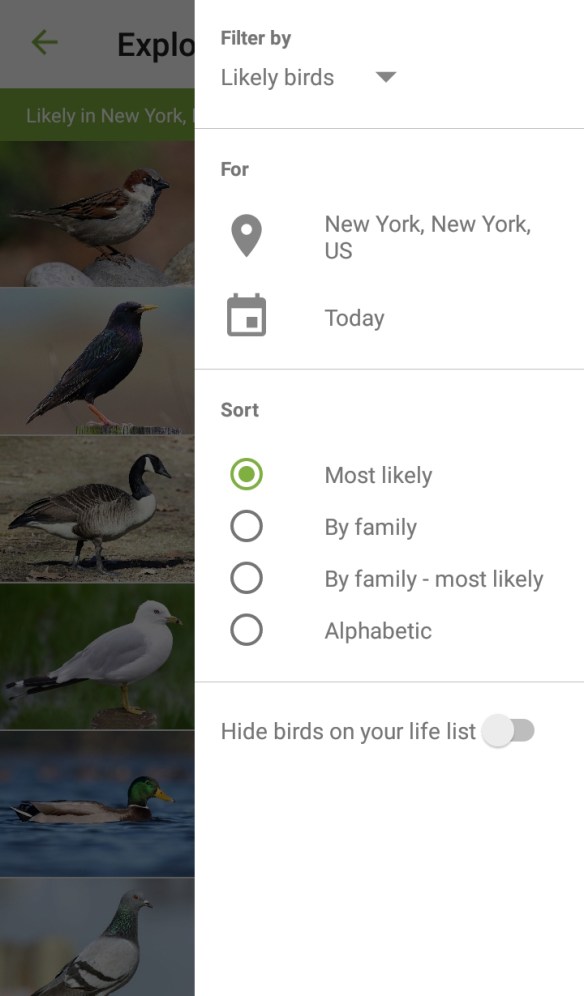
 

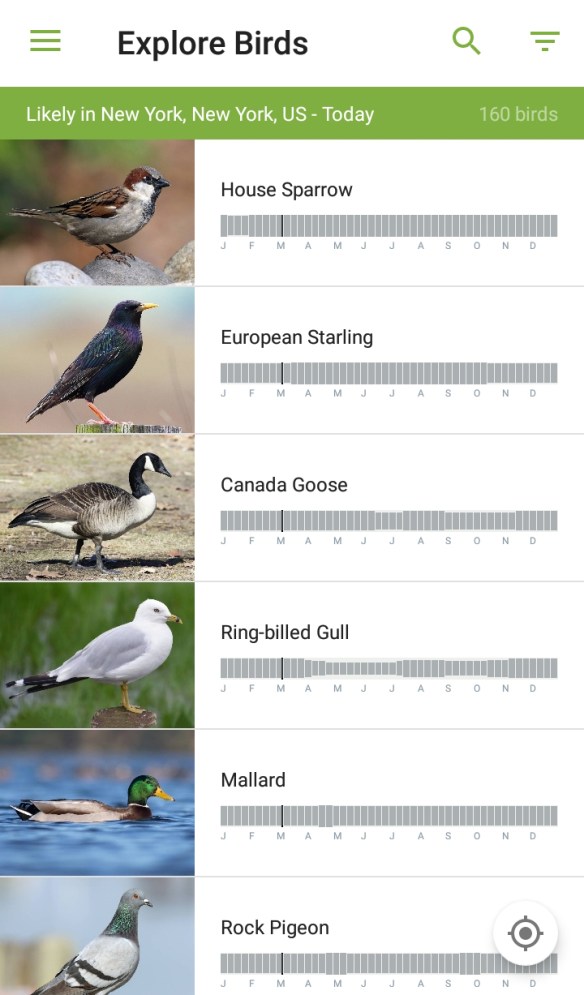
4) You’re done! The app should now be displaying something like this:
MerlinS2


The app displays birds roughly in the order of how abundant they are now at the location you have selected, which for us is New York City. This ordering is useful, as you want to learn the most common birds first, as they are the ones you will see most often and you do not want to be confused about them.

Clicking on any element of the list takes you to an entry containing more photos of the bird, a brief description of the bird’s behavior and appearance, recordings of its sounds, and a map of the species’ range:
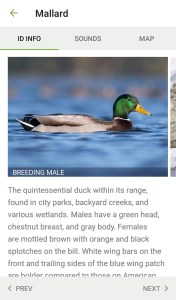
MerlinMallard


Remember that males and females of any given species might look different, as is the case with Mallards, and also with Buffleheads, Hooded Mergansers, and many others. Likewise, many birds differ in plumage based on age, like Bald Eagles and Ring-billed Gulls. Furthermore, some species look different depending on whether it is breeding or nonbreeding season for them. Spring is breeding season for nearly every species, so for now you can focus on the photos that depict breeding plumage.

Identifying birds based on their songs and calls is a more advanced birding skill, but a most rewarding one. The Merlin app has the basic sounds you need to get started.

The first 30 to 40 birds on the Merlin list should be fairly common anywhere in New York City. After that, differing habitats come into play. Because they have large coastal and saltmarsh areas, Brooklyn and Queens commonly get waterfowl and shorebirds that are quite rare for Manhattan. Current examples, for early March, are Horned Grebe and Long-tailed Duck.

Nevertheless, Manhattan does exceptionally well at getting songbirds during spring migration, and birders come from all over the world to visit Central Park and observe these birds in April and May. At least one hundred new bird species for the year will pass through Manhattan between now and the end of May.

By starting now, you can be ready to recognize the colorful birds of spring as they arrive. Different species have different arrival patterns, but in general, each has a two-week period of highest likelihood, some longer, some shorter. Any individual bird might spend only a day or two in Central Park before moving on, though some, like Cedar Waxwing and Gray Catbird, will stay for the summer and breed in the park. You continue to see many of the same migrant species day after day (until the species as a whole has passed through), however, because as some individual birds depart, others arrive.

Spring migration begins slowly, so time prior to mid-April is good for learning. You might even want to skip ahead in the Merlin settings and look, not at today, but at some future date to see what will be arriving. By late April, the new arrivals can come at a furious pace, perhaps even ten new species on a single day. It’s an exciting and beautiful time! With the Merlin app, you can be ready for it.

For instruction on how you can best assimilate all this knowledge and use it in the field, see the four Inside Birding videos from the Cornell Lab’s Bird Academy.
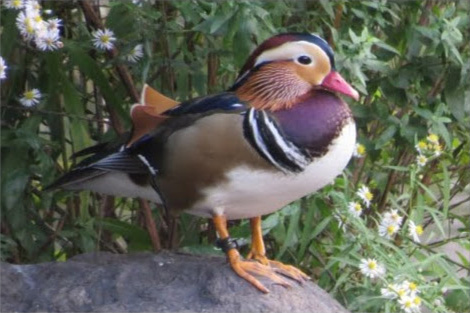


Mandarin Duck Mania, Central Park

MandarinGusKeri

Mandarin Duck by Gus Keri

Last week a certain duck became a media sensation, and I was taken along for the ride. Gus Keri’s video of the male Mandarin Duck at the Central Park Pond, posted on my Manhattan Bird Alert Twitter account,  had already gone viral over two weeks prior, when the duck first appeared there on October 10.

Jen Carlson of Gothamist interviewed me and wrote the story that introduced the broader New York world to the mysterious Mandarin Duck. Then the duck frustrated everyone by disappearing two weeks. I thought he had been eaten by a raptor.

But on October 25 we learned that the Mandarin Duck lived on, seen at the 79th Street Boat Basin on the Hudson. By Sunday, October 28, the Mandarin Duck had returned to the Central Park Pond.

Julia Jacobs of the New York Times met with me to view the duck on October 30, and her brilliant story was published early the next morning. It quickly became the most popular story on the New York Times website and was liked tens of thousands of times on Twitter.

Since then, I have been doing a great many interviews with reporters from news organizations all over the world about the Mandarin Duck, which continued to draw hundreds of admirers to the Central Park Pond this last weekend hoping to see and, better yet, take a photo or video of the vibrantly-colored bird.

Many are finding joy in observing the Mandarin Duck, and I am delighted that my alerts account has been able to help them locate him and display their footage.

Let’s be clear: this Mandarin Duck is of domestic origin. He is not a wild bird, and he certainly is not ABA-countable or eligible for the eBird database.

Right now, though, he is New York City’s most famous duck, and we are glad to have him.


Dickcissel and Pine Siskin, Central Park

Dickcissel, Central Park North End

On migration-season Fridays, Robert DeCandido offers a birding walk in the Central Park North End. He starts early, 7 a.m. or so, well before the scheduled walk time of 9 a.m., to scout the area and also to get in some good birding at the best time.

Two weeks ago he found Orange-crowned Warbler and Yellow-breasted Chat on his scouting walk, the first of which he tweeted while I was still in bed, so the chase took a bit longer than I would have liked.

On this last Friday, August 24, I was up earlier, so that when Robert’s 8:00 a.m. tweet of a Dickcissel opposite the Green Bench arrived, I did not have much left to do to before going on my way.

It’s remarkable how this small area, around the Green Bench, produced two rarities worthy of regional mention in a short time frame.

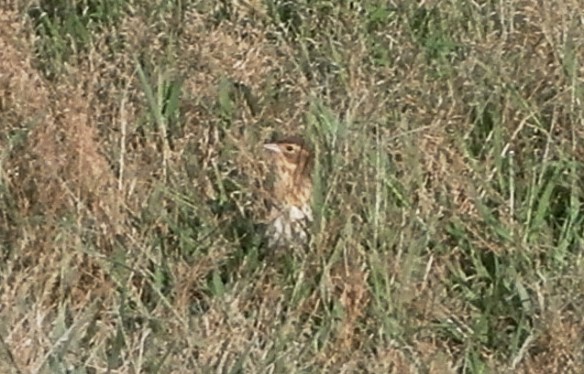
I ran and reached the location by 8:27, and within a minute I saw the Dickcissel poking its head above the grass. I even got a decent photo.

Dickcissel is not recorded every year in the park; the last known appearance of it there was noted by only one birder in October 2016. Before that, Robert DeCandido and Deborah Allen found one on the Central Park Great Hill on 27 May 2016, and I quickly chased it and saw it along with Deborah.

I am delighted to have had at least one Dickcissel in Manhattan every year from 2011 to 2018.

Today, August 25, Robert DeCandido continued to produce. I joined him for a walk around the Ramble on a pleasant but not-too-birdy morning. The Ramble was alive with the calls of Red-breasted Nuthatches. Altogether I had at least ten of them.

We saw and heard several of them in the trees of Bunting Meadow, immediately north of the Upper Lobe. Robert noticed another, drabber bird associating with the nuthatches, one with brown streaking on the breast and a sharp bill — an unexpected Pine Siskin, the first of the year for Manhattan! This also is the earliest-recorded fall date on eBird of a Manhattan Pine Siskin.


August Rarities in Central Park

After warning Manhattan birders from my @BirdCentralPark Twitter feed that Thursday-night radar was lighting up and that the morning could bring some good birds, I planned on looking for shorebirds in Inwood. I had already observed nearly every bird likely to occur in Central Park in the spring.

Those plans changed quickly, on Friday, 10 August 2018, when Robert DeCandido sent a 7:56 a.m. alert of Orange-crowned Warbler in the Central Park Wildflower Meadow, a species I still needed for the year. (As did nearly everyone else. Unlike 2017, when Orange-crowned Warbler was seen often during spring migration, 2018 brought perhaps only one such bird, seen on only one day.)

As I was getting ready to run to the North End, DeCandido found and reported another rarity: Yellow-breasted Chat southwest of the A. H. Green Bench, near the Wildflower Meadow.

The temperature was rising quickly (it would reach 86 F later) and it was a sunny day, so I knew that bird activity would soon decline. I ran to the Wildflower Meadow and looked around.

I did not see or hear any migrants, so I went to check the Green Bench area, which also had no birds of interest.

I knew that the species I was seeking almost surely were still in the area, whose dense foliage offered excellent habitat. I also knew that DeCandido and his birding group would be coming by soon, so I continued looking.

Half an hour later DeCandido and group arrived. Having Robert DeCandido around is a tremendous advantage, because DeCandido is a master of using sound to attract birds.

I have birded with him extensively, and I can relate dozens of times when no migrant activity was evident, yet after DeCandido played appropriate calls for a minute or two, warblers, vireos, and flycatchers would appear in nearby trees.

Such was the case again. We began seeing expected migrants like Canada Warbler, American Redstart, and Yellow Warbler. We even had an early Black-throated Blue Warbler.

Then DeCandido spotted the Yellow-breasted Chat again, in a fruiting tree on the northwest side of Wildflower Meadow, and everyone had great views of the perching bird.

Then we moved to the southwest corner of Wildflower Meadow, and the sounds DeCandido played drew in warblers to trees that had been empty before our arrival. We had Red-eyed Vireo, another Canada Warbler, an empidonax flycatcher, and a couple American Goldfinches.

After much waiting we noticed some rustling low in the brush, and DeCandido soon had everyone on a handsome Orange-crowned Warbler.

DeCandido’s observations of Yellow-breasted Chat and Orange-crowned Warbler set the earliest-ever records for fall migration for these species, the latter by over a month. A most remarkable morning in Central Park!

Bicknell’s Thrush, Central Park Ramble

Bicknell’s Thrush (from allaboutbirds.org)

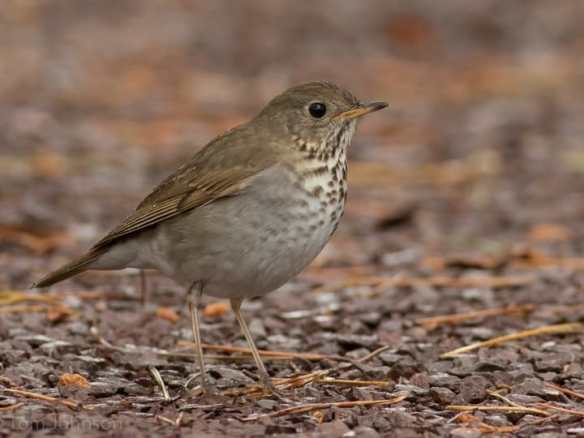
This morning Roger Pasquier heard the song of a Bicknell’s Thrush at Evodia (the Ramble bird feeder area). He later told Anthony Collerton about it and pointed out the bird, a warm-toned thrush associating closely with a grayer Gray-cheeked Thrush. Collerton issued a Manhattan Bird Alert (follow @BirdCentralPark on Twitter) to let everyone know. He himself had not heard the bird sing.

I arrived at Evodia some minutes later, after Collerton had left, and quickly found a pair of thrushes on the east side of Evodia that matched the stated description. I announced my find to other birders nearby just as the bird was flying to the west side of Evodia.

As I have written before, visual identification is not sufficient to claim a Bicknell’s Thrush, as Gray-cheeked can look much the same. One needs to hear the Bicknell’s song, which ends with a thin, rising pitch.

Both thrushes were staying silent and had wandered out of view. When we started playing the Bicknell’s song on a mobile phone, one of the thrushes came back into view and perched overhead, calling “whee-er”. Soon it flew down and sang. We had our Bicknell’s!

Shortly thereafter I called it in again for Anders Peltomaa and Al “Big Year” Levantin and elicited singing in response. Same later for Joseph DiCostanzo and his American Museum of Natural History walk.

I also heard the Bicknell’s Thrush sing on its own, unprompted, just east of the Gill Source at 10:18 a.m.

A half-hour later Robert DeCandido came by Evodia and helped members of his birding walk see and hear a singing Bicknell’s Thrush.

American Bird Conservancy President Mike Parr and his group were nearby at the time and might have heard the Bicknell’s song. To be sure, I used my phone to call it back again and everyone got close views of the calling and singing  bird.

Bicknell’s Thrush remains a rarity not just in Central Park but throughout its tight migration range along the East Coast. Since identification requires hearing its song, it is possible to get it only during spring migration. Even then, the time window seems to be narrow — I have never had Bicknell’s on more than one day in any May, and there are usually at most only a few days in any May when I hear much thrush song in Central Park. The possible date range for it here seems to be May 12 to May 25, judging by historical Central Park records and my own experience.


Kirtland’s Warbler, Central Park

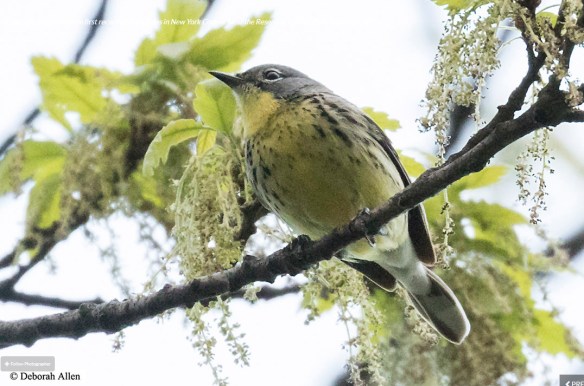
When I saw Kevin Topping’s 5:05 p.m. tweet of a “possible” Kirtland’s Warbler on the northwest side of the Central Park Reservoir, I immediately relayed it to Manhattan Bird Alert (@BirdCentralPark). Of course I had some doubts — Kirtland’s Warbler had only one confirmed eBird record in all New York State (2014, Hamlin Beach State Park on the shore of Lake Ontario), and a female Canada Warbler would be at least 10,000 times more likely.

By 5:15 I had heard from a friend that Kevin was “fairly sure,” so I got ready to chase. Along the way I received a photo of the bird, which strongly supported the ID.

Because I did not know the exact location of the bird, I ended up taking the longer route around the east side of the Reservoir. I finally saw Kevin at 5:31 p.m. at 91st Street and West Park Drive, but he no longer was on the bird.

Then Ryan Zucker arrived, and soon he and his mother had re-found the bird slightly northwest of the previous location. From that point forward the bird stayed in view, sometimes moving from tree to tree but remaining in the same general area, where it had an abundance of insects on which to feed. It had been a hatchout day in the park, and many other warblers were enjoying the feast.

On the way I had privately posted Andrew Farnsworth of the find, and by 5:58 p.m. he had it, too — the only bird native to the continental United States that he had not yet recorded.

It likely is the rarest bird that has been found in Manhattan during the time I have been birding. By the time I left at 6:29 p.m. over 100 birders were on the scene.

Surely some birders will be traveling to Central Park tomorrow from all over the region, hoping to re-find this bird. Manhattan Bird Alert will try to keep everyone informed!


Boat-tailed Grackle, Central Park

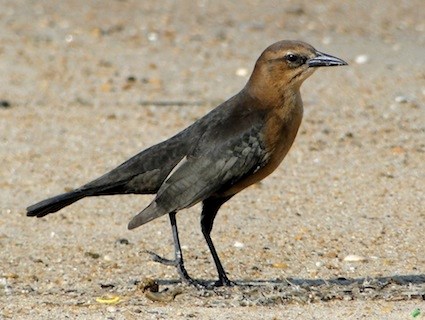
Female Boat-tailed Grackle (credit: AllAboutBirds.org)

As I have written before, Boat-tailed Grackle is not a species you should expect to find in Central Park even though it breeds in the New York City area and in neighboring New Jersey. When it is reported in Central Park, it is almost always a mistake. Common Grackles vary in size and tail length, and if you look at hundreds of them you are likely to find some that look larger than the others. A male Boat-tailed Grackle is not easily distinguished from a large Common Grackle by appearance alone, though the rounder crown shape of the Boat-tailed and the very large tail, often held in the shape of a “V,” are key features. Song and calls diagnostic for distinguishing these two species.

If you want to confidently identify a Boat-tailed Grackle amidst a loud flock of Common Grackles, your best hope is to find a female or immature. It’s overall brown color suggests Rusty Blackbird, but its long, thick bill and much larger size (as large or larger than Common Grackles) easily clinch the ID.

Recently in Central Park eBird reports of female Boat-tailed Grackle have appeared, with the first being on November 17. This report failed to give a specific location and was entered after sunset, despite referencing a morning birding time. A more reliable report, complete with photo and Sheep Meadow location, was submitted on November 25. This one also was entered late, but not so late as to make chasing impossible. I received the eBird alert at 2:49 p.m. and shortly after 3:00 I was running to the southern end of the park to do some searching.

By then the large grackle flock reported and photographed in the early morning was gone. It was a mild day, and the Sheep Meadow and surrounding lawn areas were filled with people. I found a smaller Common Grackle flock in the trees of the Hallett Wildlife Sanctuary, but I could not pick out any Boat-tailed Grackles.

The following day, that of the Hammond’s Flycatcher discovery, another eBird report listed Boat-tailed Grackle. this time in the Ramble where I had already spent much of the day.

Two days ago, on Saturday, December 2, I had what I thought was a prime opportunity. A user of Manhattan Bird Alert reported a female Boat-tailed Grackle among a large Common Grackle flock on Cedar Hill. Minutes later, as I was on my way, this finder noted that the flock had been startled and flew south toward the Boathouse. Despite much searching in that area and in areas to the south, I never found the flock.

Another bird alerts user reported seeing the flock at Maintenance and then watching it quickly fly north. I headed north, scanning the lawns on the park’s west side. I did not find any grackles whatsoever.

Yesterday I was birding with Robert DeCandido and Deborah Allen’s group, which was on its way to the Pond to see warblers and waterfowl. I remarked to Robert, as we were passing Cedar Hill, to keep an eye out for grackle flocks.

As we approached the Sheep Meadow, I saw a massive blackbird flock — hundreds of Common Grackles along with many European Starlings. I quickly eyed a leucistic Common Grackle, and remarked that it probably was the same one photographed on November 25 in the flock with the female Boat-tailed — which might be here, too.

The flock flew west, re-settling on the northwest corner of Sheep Meadow. I ran to chase it, and began scanning. Soon another member of the group spotted the immature (likely female) Boat-tailed Grackle under a nearby tree. We got close looks and were able to take good photos.

For me and everyone else in the group it was a new lifetime bird for Central Park. We later had the bird again that day in the trees of Hallett.

Prior to November, the last verified report of Boat-tailed Grackle in Central Park was on April 20, 2011 — a male that seemed to have been lingering in the area south of the Meer for perhaps a couple weeks, and whose distinctive sounds were noted.


Virginia Rail, Central Park Ravine

Coming into today, November 23, my chances to get Virginia Rail for the year were looking slim. The species had already made more than a few appearances in Manhattan in the fall migration season. We know this because the Wild Bird Fund (WBF) on the Upper West Side had treated at least six Virginia Rails. Most of these birds apparently had collided with buildings and clearly were injured.

On September 21 a Virginia Rail was found by Bryant Park maintenance staff in the typical place where rails or woodcocks appear: the southeast maintenance shed, which is surrounded by vegetation and offers birds privacy and shelter. It was said to look “stunned.” Staff immediately called NYC Audubon, and the rail was taken away to the WBF before any public reports were issued. The bird recovered and was released sometime later.

The morning of November 8 offered the first chaseable report, at 8:10: a birder on his way to work noticed a Virginia Rail perching on a Lexus near 48th Street and Park Avenue in midtown, and suggested that the bird might be in need of rescue, though it did not appear to be injured. (Kudos to the bird for having chosen a notably safe and well-engineered vehicle.) Having stepped away from my computer, I was five minutes late in reading the post. I then took a few minutes to relay the report to followers of Manhattan Bird Alert, some of whom surely would be nearby and might be able to step out for a look. Then I got dressed and headed for the subway to begin the chase.

Because of the time — right when or just before most people begin their workday — I did not expect anyone to attempt a rescue, which would minimally require an hour of commitment, between catching the bird, transporting it to the WBF, and then returning to work. My response was not going to be my fastest — I would normally aim for 25 minutes from alert to arrival in midtown — but I did not see how it was going to matter.

I caught the Lexington Line 6 train with only a short wait and was headed to midtown. At 8:42 I was approaching 59th Street and feeling confident that I would get the bird, which might be only five minutes away.

Then I saw a new message on my phone: someone had already captured the bird and set off for the WBF!

This was a first for me. I have done many chases over the years, surely at least a hundred involving some cross-town travel, but before then my attempts had been foiled purely by natural forces — mostly by birds simply choosing to go somewhere else. This was the first time a  human had seized a bird and spirited it away before I could see it.

Proof that the capture likely was unnecessary came within minutes: the Virginia Rail squirmed free of its captor, who had snared it in a cloth bag, and flew off west on 47th Street. Had the captor thought to post this news then, I would have been nearby and ready to continue the interrupted chase. But birders were not apprised of the escape until over an hour later. The bird was not reported again.

Today, in contrast, everything went right. One of Manhattan’s top birders, Stefan Passlick, found a Virginia Rail on the west side of the Ravine in Central Park’s north end. He posted clear directions to it along with a Google Maps screenshot at 2:02 p.m. on Manhattan Bird Alert. I ran to the scene and immediately saw the rail foraging nearby in front of a log in the moist, leaf-covered area — exactly where the Google Maps pin indicated it should be. This was easy!

Soon others showed up, and all were treated to close, extended views of a Manhattan rarity that was largely oblivious to the observers and their cameras. It was a delightful way to end a fine day of Thanksgiving birding.

This bird went onto linger at the location for many days.

The Wild Bird Fund later announced that it had released a rehabbed Virginia Rail in the North Woods on November 21. Whether or not this was the bird seen by many cannot definitively be determined and does not affect the ABA-countability of the bird.


Snow Buntings, Randall’s Island

OLYMPUS DIGITAL CAMERA

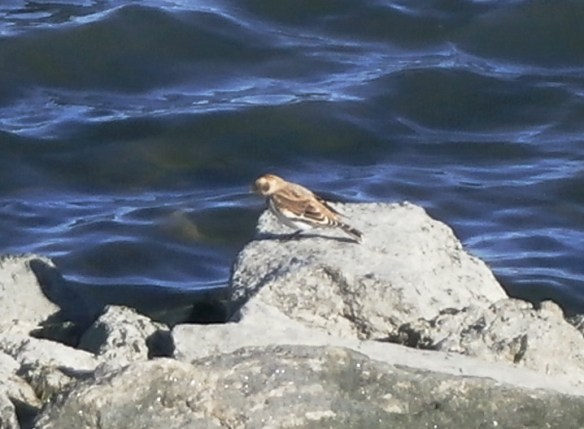
Snow Buntings are a rarity for Manhattan. I am delighted to have had them for a second time this year (the first was on February 14, at the same location). Yesterday, November 11, I saw and photographed two Snow Buntings on the rocky northeast shoreline of Randall’s Island, opposite ball fields 39 and 40. They have been reported continuing at the this spot again today.

In other birding news, the cold front that passed through on the morning of November 10 brought strong northwesterly winds all day, which led to decent raptor and waterfowl flight. It was the first productive day for observing diurnal flight in Manhattan for over a month. We have been stuck in a cycle of either southerly winds (driven by strong low pressure systems) or northeasterly winds.

The latter are generally unproductive for seeing raptor flight over Central Park, as birds, which want to move west away from the coast anyway, are deflected even further west, over the Hudson and into New Jersey. For example, on November 8 the Quaker Ridge (CT) hawk watch had a record-high one-day total of 277 Red-shouldered Hawks. Manhattan birders reported none that day.

At Inwood Hill Park on November 10 I tallied some new birds for the year: Northern Harrier, Bonaparte’s Gull, and Snow Goose, bringing my 2017 New York County total to 209.  I had only a single Red-shouldered Hawk there. I had Northern Harrier in Central Park again upon my return just before 2 p.m.

Great Horned Owl, Central Park

Yesterday, October 30, a Great Horned Owl was found roosting at nearly tree-top level in an oak at the southwest corner of Evodia Field (where the bird feeders are) in the the Central Park Ramble.

I issued a Manhattan Bird Alert (follow @BirdCentralPark on Twitter) as soon as I saw the owl, but clearly many before me had seen it and not done so. That’s a shame. Nevertheless, a lot of people who would have otherwise missed seeing this infrequent Central Park visitor were able to hurry to the Ramble in the roughly 50 minutes of daylight remaining and see it.

Based on the questions I received on Twitter, some simply did not know that it was OK to issue a bird alert involving an owl. It is — at least on my service, which has over the years helped birders observe many owls, including Barred Owl in April of this year, Long-eared Owl in December 2016, and Eastern Screech-Owl in October 2016. Some other listservs and discussion groups still try to restrict such information, a quaint policy in 2017 given the popularity of sites (Twitter, Instagram, Facebook, etc.) on which information can be disseminated freely.

Others wondered if it was ethical to report owls publicly. I would argue that it is almost always fine to do so at public locations in Manhattan. Of course “ethics” is a social construct, one that varies widely among people and times. Decide for yourself. But if you adopt a point of view simply because you see it written somewhere or hear it told to you, you are not doing your own thinking.

We report hundreds of other bird species, and sometimes they draw large crowds. Think back to last spring’s Cattle Egret or Least Bittern. Surely these birds were aware of increased human presence. Yet no one would fault the people who issued alerts on them. The birds lived on just fine, with the former remaining four weeks in a urban area dense with people and machinery.

You cannot reasonably argue that yesterday’s Great Horned Owl, resting nearly hidden over 60 feet above the ground, was bothered by a group of people quietly standing still and looking up at it. People would have been passing by the area all day anyway. The owl was partially obstructed from any vantage point, and it appeared to be looking away from the viewers.

Owls deal with more proximate annoyances nearly every day as they roost — other birds (Blue Jays, crows, even hawks) getting right in their faces, screeching loudly and mobbing them. That is usually how we humans find roosting owls, and how yesterday’s Great Horned Owl was found.

Some worry that non-birders or bird photographers will behave badly in the presence of an owl, but I have never seen this happen in Central Park. A large group of viewers, with mobile cameras ready to record any malicious deeds, is actually a source of safety for both people and owls. Park Rangers often are deployed to monitor owls and keep viewers in line, too.

But aren’t owls rare and endangered? No, not the ones we get in Central Park. They may be rare locally (in the park), but broadly — even just in New York State — they are doing fine, and are rated by the IUCN as populations of “least worry.”

But they rest during the day — doesn’t this make them special? Yes, it is an uncommon trait, but nighthawks and nightjars also are nocturnal, and no one seems to mind that these roosting birds (e.g., Common Nighthawk, Eastern Whip-poor-will, and Chuck-will’s-widow) are reported and viewed by large groups.

And why should they mind? Again, these are not endangered species, and a gathering of humans observing them is the least of their problems. They get pushed around by both mammals and other birds during the day, and sometimes they fly off and rest somewhere else. Same with owls. That’s life for a nocturnal bird.

The issue of nesting owls is more complicated and sensitive, but Central Park does not have any.

If you accept that even “ethical” birders might occasionally flush a flock of Chipping Sparrows feeding on a lawn, then why all the fuss over respectful birders who sometimes merely draw the attention of roosting owls?

Yet many birders carry a double standard — one for owls and another for all other birds.

On top of this they add hypocrisy. They don’t believe in publicly reporting owls because they say the number of viewers should be minimized, but they themselves will race out to see any owl that they learn of publicly or privately. And once they see it, they call or text their friends to pass along the news.

This process has a number of problems, among them: it’s slow, and it’s not fair — many people get left out of the loop.

Everyone wants to see owls, even people who otherwise do not go birding. Owls are fascinating and mysterious, and seeing them in Manhattan is a rare treat, one that should not be just for the select few. Think about how glad you were the last time you got to see one. With little or no detriment to the owls, the benefits and costs are much the same as for birding in general.

Manhattan Bird Alert wants to help you see your next owl. For this to happen, owl finders need to report promptly. Many will thank you for your tweet, even if a few curmudgeons sniff at it. If you would rather report anonymously, just send @BirdCentralPark a DM (direct message) on Twitter or email me privately. If you prefer to post on eBird directly from the field, that works, too — alerts are issued almost instantly and I monitor them and will relay them.

November is the best month for Manhattan owling. Let’s have a good one!