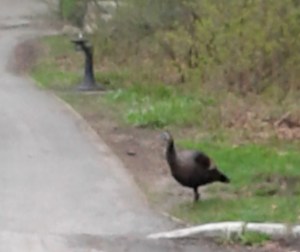
Wild Turkey, Central Park

WildTurkey2

Wild Turkey at Maintenance area

An hour after sunset on Thursday, April 20 eBird relayed the report, with photos, of a Wild Turkey at the north end of Central Park, by a stream known as the Loch. I immediately tweeted the report to followers of Manhattan Bird Alert. The bird was said to be lingering at the Loch, flying back and forth over it, and allowing close approach from people. None of this is surprising for a Wild Turkey, but it is odd that no regular birders were there, at a recently very popular warbler spot, to observe and report it in real time.

It rained over Thursday night, during which time the turkey presumably would have roosted in a tall, nearby tree.

On Friday morning the search was on, with birders (including me) scouring the Loch and nearby North Woods\. The latter would make excellent turkey habitat and would have few people to disturb it. None of us found it that morning, nor was it reported elsewhere in the park. How could a large, conspicuous bird, one that moves around mostly by walking, suddenly disappear?

Then at 6:33 that evening a new lead emerged: an eBird report by a Brooklyn birder of Wild Turkey earlier that afternoon at Turtle Pond. Was I being pranked? The Ramble had many birders active in the afternoon who would have issued text alerts had they seen it, and Turtle Pond receives a huge amount of foot traffic.

I ran to Turtle Pond to investigate. Since it was getting late, I checked the trees, too, for a possible roosting bird. Still no turkey.

I figured that nearby Tupelo Meadow would be a pleasant spot for a Wild Turkey, so I checked there. Maintenance Meadow would be also make a quiet foraging spot, but again, no bird.

Then I saw it, a large, dark blob walking slowly aside the paved path immediately east of the Maintenance tool shed:

WildTurkey1

This Wild Turkey was the first documented appearance of the species in Central Park since January 2009, and the first for me in the park.

It remained in Central Park yesterday (Saturday), ending up in the Cherry Hill and Falconer’s Hill areas after appearing early in the east section of the Ramble.

Today (Sunday, April 23) it was spotted on a lawn at the extreme southwest corner of the park near Columbus Circle.


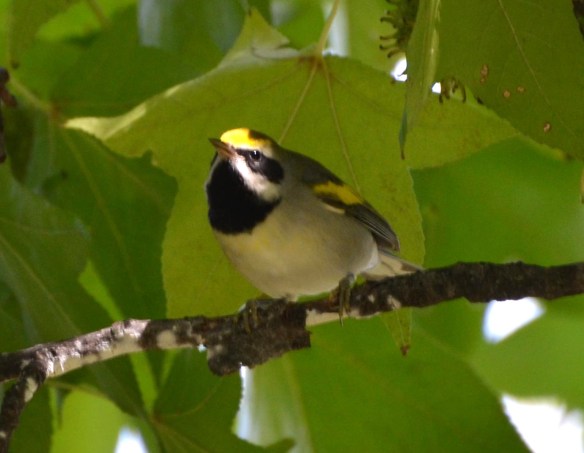
The Elusive Golden-winged Warbler

GWWarbler

Golden-winged Warbler (Wikipedia)

The last section of my book discussed relative warbler rarity in Manhattan. At the time I wrote it, I did not believe that enough eBird data existed to reliably choose which of the 36 regularly-occurring warblers was the rarest (I settled on a top six). Four years later it is safe to say that this title goes to the Golden-winged Warbler.

[This species has suffered a severe decline in population. The Cornell Lab of Ornithology offers an excellent explanation here.]

I was fortunate to see one in September 2012 with many other observers at Strawberry Fields. The bird had been reported there at least twice, beginning in late morning, so it definitely was lingering in the area. Even so, observing it again required two hours of watching and waiting.

I vaguely recall a reliable message-board report of a Golden-winged Warbler at Maintenance in the fall of 2013, but it came much too late — perhaps the following day — to chase it. There also was a text-alert issued for one in the fall of 2014 at the Upper Lobe, which many chased — I was on the scene in ten minutes — but no one found.

Just this last May (2016) Andrew Farnsworth had a Golden-winged Warbler in East Midtown, but the bird was moving through trees so quickly that he was unable to keep it in sight and I abandoned the chase within minutes.

Fast-forward now to this past Saturday, 3 September 2016. At 4:16 p.m. Manhattan Bird Alert (on Twitter) was issued for a Golden-winged Warbler at Maintenance by the fenced-off storage area. I was there in ten minutes, but I saw no birders looking for it — a bad sign. Eventually the man who issued the alert returned, and in conversation I found that the alert actually was issued almost at least a half-hour late because of “technical difficulties” — which is to say an unlikely combination of a yet-earlier finder’s phone running out of power and  the eventual alerter initially sending his alert improperly so it was not re-tweeted.

Give a Golden-winged Warbler a half-hour head start late on a windy day and odds are it will not be found. I searched for two hours, and was later joined by upwards of ten other birders. No one got it. Still, a clear photograph of it perching by the chain fence was later posted on eBird, leaving no doubt that a male Golden-winged had been present earlier.

The very next morning Deborah Allen sent a Manhattan Bird Alert of a Golden-winged Warbler at 8:00 a.m. on the south end of Maintenance. I was in bed and did not see the alert until 8:07. Twenty minutes later I was at Maintenance looking for the bird, which turned out, as I learned from Deborah, to be different from yesterday’s — this time a female.

It was a pleasant, clear Sunday, and many birders searched Maintenance and the surrounding area trying to find the Golden-winged. Again, none succeeded. It appears that there was again a delay (11 minutes) from initial sighting to the time of report. I did not have a good reason to be birding early that morning, as the northeast winds, blowing for a second straight night, were likely to drain the park of birds while doing little to refill it, and that is just how things went. My response to the alert was slow, but another birder already was in the Ramble and chased the alert immediately. He did not get it, either.


Late summer report

Winter birding season really was poor

I complained in my Winter Birding Review that, although I ended the winter with a fine species total (86), I — and nearly everyone else — missed many essential winter birds. Species totals were padded by late-lingering fall birds that would be easy to get in the spring.

Once spring migration was over the effects of this bad winter were more clear. I went into June with only 175 species as compared to the 180 I had then in 2015 and the 182 in 2014 despite having an above-average spring.

Spring migration season was very good

All of the expected birds appeared, and did so in decent numbers, arriving at anticipated times. Arrivals were spread out well, too — unlike in 2014, when migration was delayed by a couple weeks of bad weather before a massive surge concentrated over several days.

Many of the expected but more difficult species were relatively plentiful and easy to observe, with numerous alerts making the job of finding them still more efficient. A female Cape May Warbler, for example, showed up early at the Oven and lingered there for nearly two weeks. Later, Cape Mays gave great, close views in the trees surrounding Turtle Pond, as did Bay-breasted. Yellow-throated Vireo was observed multiple times on many days. A White-eyed Vireo lingered for over a week at the Maintenance Meadow. Both Yellow-billed and Black-billed Cuckoos also made frequent appearances, many of them text-alerted. Mourning Warbler had at least several very chaseable alerts — I ended up seeing it on two occasions.

It was also a fine spring for observing the rarest warblers, which last year did not make much of a showing. Most notably, Kentucky Warbler made a brief but well-followed appearance in the Tupelo Meadow/Maintenance area on the same day (19 May) morning that a Cerulean Warbler lingered near the source of the Gill. Over a month earlier Yellow-throated Warbler showed up in the Maintenance Meadow and re-appeared the following morning. A Prothonotary Warbler was reliably reported on 27 May but was not re-found.

It also was an excellent season for unexpected rarities. I had a close view of Purple Sandpiper on 25 April on the southern tip of Roosevelt Island. Now that this species has been observed there in two consecutive years, perhaps it should be considered a regular visitor? 8 May was a notable day: an American Bittern was found at the Oven and seen by many, as was a Chuck-will’s-widow at Muggers Woods — making 2016 the fourth consecutive year in which the latter has been seen by multitudes in Manhattan. On that same day Andrew Farnsworth had Glossy Ibis over the East River and Golden-winged Warbler near Sutton Place. Let’s also remember the best bird of them all, the Swainson’s Warbler of which I wrote, and not far behind it in terms of rarity, the Seaside Sparrows. It was also a treat to get a clear, close (as opposed to high flyover) view of a male Bobolink in Central Park.

That said, empidonax flycatchers were very rare this year. I had Acadian in the Ramble, and it also was heard on a couple other days. But there were only single reports of Yellow-bellied , Willow, and Alder in Central Park, and I did not have them.

I also missed Blue Grosbeak.  I chased a report of it with Tom Fiore and another birder on the afternoon of 12 May. After Tom and I set out on a different trail, the bird almost immediately reappeared for the third birder who had stayed behind. None of us ended up seeing it again despite hours of search.

Summer has been mildly disappointing

Summer is not over yet, but it has been filled with misses.

I ventured out to the Meer and Turtle Pond at least six times around sunset in June and July in search of another Black Skimmer, but did not see any.

I also made eight trips to the Inwood area in July and August in search of shorebirds and others. All I got out of it were the two most common species I expected to add, Semipalmated Sandpiper and Least Sandpiper.

A juvenile Little Blue Heron on was seen and photographed at Spuyten Duyvil Creek on July 30. Had it been reported immediately, I almost certainly would have been able to reach it in time to observe it, but the finder apparently was not initially sure of the ID. I raced to the scene within an hour of the alert, but by then the tide had risen, the mud had disappeared, and the bird had moved on.

I was, however, delighted to hear a Willow Flycatcher calling on 18 August in the Ramble and  a Red-breasted Nuthatch, also calling,  near Delacorte Theater the following morning.
 

Bobolink, Central Park Oven

The Bobolink in general is a common bird, but it is a very difficult one to observe in Manhattan. Venture a few miles west, to the New Jersey Meadowlands, or to the coastal marshes of Brooklyn and Queens, and you can find plenty of them during spring and fall migration. You also can observe their migratory flights very early in the morning over Manhattan. Sometimes you can hear their flight calls. Rarely they alight on trees in Central Park in passage, never lingering long before continuing on.

Around 10 a.m. today I encountered AMNH Ornithologist Joseph DiCostanzo and Lenore Swenson in Tupelo Meadow. They told me that they had learned of a male Bobolink in the Oven forty minutes prior, and that they had observed it themselves before it flew off and was not re-found. Joe had attempted to issue an alert on the bird but the email apparently did not go through.

I had come across Bob “Birding Bob” DeCandido and his group earlier and I was birding with them when I got the news. We eventually made our way to the Oven but did not observe the Bobolink. Along the way we had a mystery flycatcher, seen only briefly, and my first-of-season Ruby-throated Hummingbird at Maintenance Meadow.

As a small digression, I should mention that I had a great time birding with Bob. Many know that Bob uses recorded calls and songs to draw in birds, as do many top birding guides. Birds that are perching still sometimes move and reveal themselves; some birds that are out of sight will fly in to check out the commotion; and some that are in sight but high up will descend to levels where they are more easily viewed. The result is that members of Bob’s group see a lot of birds and often get excellent views of them. I certainly had better views than I usually do on my own.

Yesterday, Bob found a Yellow-billed Cuckoo in Tupelo Meadow. I had remained in the Maintenance Meadow, along with many others who were part of a different birding group. Bob ran back to Maintenance to let everyone — not just his group — know of the cuckoo. We enjoyed extended views of the bird flying and foraging high over Tupelo.

Today, after initially striking out at the Oven in search of the Bobolink we moved on to Swampy Pin Oak. Warbler Rock, and the Rustic Shelter, where we saw Indigo Bunting, Great Crested Flycatcher, Eastern Kingbird, and Blackburnian Warbler, among others..

Bob suggested we finish with one more pass over the Oven and then onto the Point. As we we turned onto the dirt path leading to the Point, I began to hear Bobolink song. So did Bob, and he already had the bird in sight, atop a bare tree over the Oven. The Bobolink continued singing loudly, moving around to various high perches both at the Oven and later toward the north to the Captain’s Bench area.

This was my first visual Bobolink in Central Park — I had heard one singing two years ago in the North Woods. What a way to end the morning! With the temperature rising and warblers becoming more scarce, I headed home.


Seaside Sparrow, Hudson Greenway

Thursday, May 5, was cloudy and cold — just like most days this last week. I had taken a walk in the afternoon to the North End as much for exercise as for birding. When I returning home shortly after 4 p.m. I figured I was done for the day.

But at 6:26 p.m. a Manhattan Bird Alert came through from Adrian Burke: he had found three Seaside Sparrows at a small park known as Clinton Cove at 55th and the Hudson Greenway.

My first thought was, “How can I chase these birds?” I live on the Upper East Side, so I would have go entirely across town and then roughly a mile south. I ran across the park to the AMNH subway stop at 81st Street and immediately caught a southbound train to 59th Street. From there I ran to  the location.

Seaside Sparrow is one of the very rarest Ammodramus-type sparrows for Manhattan. There are records on eBird, all in Central Park, from 1923, 1974, and 2011. I had one briefly in October 2014 on Randall’s Island’s northeast saltmarsh, a place you would expect the species, as it gets Nelson’s Sparrows annually.

Where I found Adrian Burke and the sparrows was not at all a place that a Seaside Sparrow should want to be. The three sparrows were moving quickly on foot on a narrow median strip of mostly bare ground and some plants and trees between a paved lane for runners and cyclists and a paved lane for pedestrians.

Walkers, runners, and dogs occasionally scared a sparrow to short flight, but they remained in the area. One ventured onto the eastern edge of a large lawn on the Hudson side.

I was first on the scene, and, along with a couple others who showed up, got great views from less than ten feet. The sparrows appeared not to mind our presence as they went about their foraging.

These sparrows went on to defy expectations by remaining at this location during both the following day and the day after that — today, May 7.

Another Seaside Sparrow was found at 65th and the Hudson Greenway on the morning of May 6. It, too, has remained in place since then. A fourth Seaside Sparrow appeared at the Clinton Cove location, also on May 6. An American Kestrel was observed catching and carrying away one of the Clinton Cove sparrows that same day.


Swainson’s Warbler, Strawberry Fields

Last night’s winds looked unfavorable for birding this morning. For the first few hours after sundown they were light and southwesterly, encouraging Central Park migrants to fly out. Later they switched to northwesterly, discouraging flight into the park. So I did not intend to do any early birding, and temperatures in the low 50s only strengthened the case for waiting.

After seeing #birdcp Twitter reports before 7 a.m., I knew that some good birds probably had remained in the park — Nashville and Worm-eating Warbler, for example. But I had already observed these in recent days and had no interest in chasing them.

As I was having breakfast a 7:22 a.m.a Twitter alert arrived, issued by Alice Deutsch, one of the park’s most expert and well-traveled birders: “Swainson’s Warbler, Imagine mosaic.” My first thought was that she meant Swainson’s Thrush, a common bird but one that would be early and first-of-season for Central Park, so worth reporting. But a few minutes later she tweeted, “Confirming, and it’s singing.” It had to be a Swainson’s Warbler, just as she had written — she would not bother confirming a common thrush, nor would anyone care that one was singing.

This meant I had to get to Strawberry Fields — fast! No time to finish eating. I put on running clothes, packed my bag, and I was out the door.

At 7:46 I arrived at the mosaic to see 25+ birders looking into the shrubs to the south. Almost immediately the Swainson’s Warbler sang and then popped up to perch on some foliage several feet off the ground. Then it flew another 5o feet south, landing in a tree, where it continued singing but was not being seen. Soon it was found on the ground, inside and underneath the dense shrubs. This is where it stayed during the time I viewed it (as late as 9:35 a.m.) and, I am told, the remainder of the day.

Within 90 minutes over 150 people had stopped by to see this rarity. It has been recorded only four times in Central Park with multiple observers (each time in May, in 1973, 1979, 1990, and 2000). A very reliable single observer had it at the Upper Lobe, briefly, in May 2012.

Yellow-throated Warbler, Maintenance Meadow

Yellow-throated Warbler is one of the six hardest-to-find warblers about which I wrote in the appendix to my book. Prior to today I had had it only twice, in late April 2012 and 2014. I, along with many others, should have had it in 2015 also, but the finders sent the alert much too late.

Today’s original finder, Kathleen Toomey — one of Brooklyn’s top birders — did not make this mistake. She reported it quickly using my #birdcp Twitter alert system, something for which she had signed up just a few days before.

I had just finished a gym workout and was at home when her 3:16 p.m. alert chimed in. I quickly changed clothes and started running. Within ten minutes I arrived at the source of the Gill and saw Kathleen and others. She said that the bird seemed to have flown north and that she was no longer seeing it.

I started searching Tupelo Meadow, an excellent place for a warbler to find food, with many tall trees starting to leaf out and some blooming. Then I circled back around Azalea Pond. No bird.

After nearly an hour of re-checking these areas, I was ready to head home. But first I wanted to try the Maintenance Meadow, which has some large trees filled with white blossoms — always attractive for warblers.

I saw a small bird with a lot of white on it swoop down from high up in the trees and land near me just a foot or two off the ground. I turned, focused, and got a brief but clear view of the bird’s grey back and crown, dark cheek, and bright yellow breast. I had re-found the Yellow-throated Warbler.

It then flew east and landed in a tree with white blooms. I knew that over twenty birders were looking for it, so I took the opportunity to send out my own Twitter alert to draw them over. When I looked up again I was no longer seeing it. This was at 4:36 p.m.

When the group arrived I passed on the information and lingered for another fifteen minutes before heading home.

It was not reported again until 6:09, at the same location, where it stayed for perhaps five minutes before flying further east and out of sight.

Winter 2016 Review

December 2015 was unusually mild, and unseasonably warm conditions continued to prevail over Winter 2016, allowing some species that are usually gone by January to linger throughout part or all of the season. At the same time these conditions discouraged a number of species that usually visit Manhattan in the winter from moving south.

The overall effect was an excellent winter species total for me of 86 through March 21, just one bird off my best (in 2013). By contrast my lowest post-2011 total was 78 last year (2015). But Winter 2015 was better than my species total for it suggests, just as Winter 2016 was not as good.

The problem is that my Winter 2016 total is padded with lingering species that I would be certain to get later in the year, and it is missing many that will be very difficult to get.

These common species that lingered include Cedar Waxwing, Ruby-crowned Kinglet, Hermit Thrush, Gray Catbird, Swamp Sparrow, Brown Thrasher, Eastern Towhee, Northern Flicker, and two warblers: Wilson’s and Black-and-white. Yes, I generally do have a few of these birds (not the warblers) during the winter, but not all of them.

I missed Lesser Scaup, which in other years was an easy winter bird, and one that is very hard to get later in the year. I also missed Horned Lark, American Pipit, both loons, Long-eared Owl, Red-necked Grebe, Long-tailed Duck, and American Tree Sparrow. Most of these species were not reported by anyone. There was a single report of Red-necked Grebe on the Hudson in Chelsea, but travel time would have made the chase odds not so good. Common Loon is still very likely to show up on the Reservoir this spring (and on the East River), but there is less-than-even chance for Red-throated Loon.

As I said in my first post of 2016, I am not planning another big year. Still, I like winter birding. Very few birders go out in the winter. Aside from the feeder area, I mostly have Central Park to myself.

Highlights

I had two life birds this winter — Lapland Longspur on January 31 and Glaucous Gull on March 6 — which is outstanding. Last winter I did not have any.

I did not write up my chase of the Glaucous Gull on the Reservoir, which was well-reported but which lingered for roughly only a half-hour after the initial report. I was particularly glad to get this species because an unexpected event forced me to cancel a visit to Governors Island in March 2015 where a Glaucous Gull ended up being observed.

I also had these very good birds: Great Horned Owl, Pine Siskin, Orange-crowned Warbler, Ring-necked Duck, Snow Goose, Common Merganser, Common Goldeneye, Canvasback, Horned Grebe, MerlinAmerican Woodcock, and Common Raven.

[Follow-up: The last ten days of the March were very productive for finding new species for the year. I added these:

87 Golden-crowned Kinglet Central Park–The Ramble 23-Mar
88 Pine Warbler Central Park–The Ramble 23-Mar
89 Fish Crow Central Park–North End 25-Mar
90 Eastern Bluebird Central Park–North End 26-Mar
91 Blue-gray Gnatcatcher Central Park–Great Hill 27-Mar
92 Osprey Riverside Park–79th St. Boat Basin 30-Mar
93 Great Egret Central Park–Turtle Pond 31-Mar
94 Palm Warbler Central Park–North End 31-Mar
95 Chipping Sparrow Central Park–North End 31-Mar

95 species is my highest-ever total through March 31.]

Sora, Central Park Loch

A substantial drop in temperature, into the low 50s, and moderate northwest winds the day and night before signaled that today could be a very good day for birding. I was expecting a strong raptor flight, which never developed. But other good things did.

I set out early to first check the Central Park Reservoir for new waterfowl and then head to the North End for sparrows and possibly Eastern Bluebird. But a text alert just before 8 a.m. of Nelson’s Sparrows on Randall’s Island’s northeast-shore saltmarsh made me reconsider. I had looked there for these ammodramus sparrows several times over the past week. And even though they generally linger for many days once they arrive, I did not want to pass up the chance to observe them when they were known to be present. I can reach Randall’s Island in twenty minutes from home, so I would still have plenty of time to chase any sightings in Central Park.

The skilled young birder who reported them on Twitter was still watching them when I arrived at 8:55. Though the Nelson’s Sparrows soon became much less active, I still saw them pop up in the low grass and reeds at least several times. We also heard an American Woodcock calling in the marsh. Further along the northeast shore we found a Lincoln’s Sparrow.

I ran back across the RFK Bridge and took the subway home. The plan was to eat, rest a bit, and then return to Central Park to watch the skies for raptors and waterfowl. Just as I was finishing eating, another text alert came in: a Sora was found in the Loch!

As I have mentioned before, Sora is a mega rarity for Manhattan. It is reported here perhaps only once every two or three years. The last one was in Bryant Park in October 2013.

I ran to the Loch, to an area between the two wooden bridges at the west end, and saw several birders observing the Sora. The bird was slowly moving along the Loch’s shore fifteen feet below in plain view, making for a very easy chase.

A Spate of Year Birds

I have not posted in a few months because I was not observing any exceptional birds. The summer shorebird season was disappointing, with nothing new for me but the common and expected Semipalmated Sandpiper. There is still time for shorebirds, as two of the best from last year arrived in the late-September to early-November period.

Raptor movements have been sparse due to prevailing winds with easterly components. Still, I have managed to see the usual Osprey, Broad-winged Hawk, and Red-shouldered Hawk, the latter two only in very small numbers.

Then, in just the last eight days, I added five new birds to my year list.

  1. Many saw the two Connecticut Warblers that lingered at in the Trinity Church courtyard on September 21 and 22;
  2. An immature Red-Headed Woodpecker appeared in the Evodia area of Central Park on morning of the 24th;
  3. An Eastern Whip-poor-will was found roosting on a tree limb at the south end of the Loch early on the morning of the 26th. I raced out to see it, and it remained there the entire day;
  4. Later, on the afternoon of the 26th I had to run out to the North End again to chase a Grasshopper Sparrow on the Grassy Knoll. It appeared furtively a few times, sometimes in flight;
  5. Today, the 29th, a birder visiting from the West Coast reported on eBird seeing a Dickcissel in the Maintenance area of the Ramble sometime between 10:30 and noon. The description checked and the other birds on his list made sense, so I ran to Maintenance shortly after seeing the 12:23 eBird Rare Bird Alert.

The eBird report suggested to me that the bird had been on the small lawn directly east of the all-metal maintenance shed. It was said to associating, as Dickcissels often do, with a flock of House Sparrows. There was a such a House Sparrow flock there, occasionally drinking from the water that collected at the base of a public fountain. I stealthily watched the fountain area for fifteen minutes. No Dickcissel.

I also checked the perimeter of the area, which included the Maintenance Meadow proper. After forty minutes I still did not have the bird.

Then I decided to look into  the northeast corner of Maintenance, where I could see some House Sparrows feeding atop tall grasses and weeds and occasionally perching on the wire fence that encloses the entrance to the shed. Soon the Dickcissel appeared on the tall grass. Of the several Dickcissels I have seen in Manhattan, this one had the brightest yellow breast. It also had a very yellow supercilium.

Paul Sweet’s American Museum of Natural History midday walk was at Maintenance, so I told Paul about the bird and he brought the group over. After some minutes of searching he found the Dickcissel perching on the tree.

The Dickcissel lingered in the general area for the entire day and was seen by many.