Boat-tailed Grackle, Governors Island

Boat-tailed Grackle breeds within a mile of Manhattan, at Liberty State Park in New Jersey, and also in southern Queens in New York City. It is a common bird within its habitat — freshwater and saltwater marshes near the coast — but this habitat does not include Central Park, nor does the bird appear with any regularity elsewhere on the island of Manhattan proper. The marshes in Manhattan, at Inwood Hill, Sherman Creek, and Randall’s Island, probably are not extensive enough to attract the species.

Though most Boat-tailed Grackles do not migrate, New York is near the northern end of their range, and eBird records indicate that these birds leave during colder months and return in late winter or spring. This movement offers a slim chance for a Boat-tailed Grackle to appear anywhere in Manhattan.

In April 2011 a male Boat-tailed Grackle showed up near the Central Park Meer. It was photographed and heard vocalizing, allowing it to be identified with certainty. At the time I was enjoying my first spring as a birder and I recall reading about the bird on a blog. I wish I had chosen to chase it, but that is simply not a thing I was doing at the time. Though I was keeping a dated list of the species I had observed, I had not yet been exposed to the notion of a “big year.” I had not yet even joined eBird, so it made little sense to go to the North End just to find one grackle with a tail longer than the other grackles.  I read that there still was dispute then as to whether the bird at the Meer really was something other than just a large Common Grackle. So I stayed away.

Within five months I was regretting that decision. I joined eBird in September 2011, and entered my list for the year, wanting to see how it ranked against others. As I relate in my book, this is when I started to think competitively about birding.

Since 2011 there has been no reliable observation in Central Park of Boat-tailed Grackle. There are only a few known records prior to 2011. Outside of Central Park but still in Manhattan, Ben Cacace had a female bird perching on Pier 11 in July 2015. The female can be identified to species on sight with much greater reliability than the male because of its coloring.

Even before the Pier 11 sighting, I had been thinking that with the species breeding on Staten Island and in Jersey City, New Jersey, it made sense to check nearby. Birds wander in search of better foraging areas.

Governors Island was on my mind as a place to look for Boat-tailed Grackle. This is the first year that the island would open early to visitors, on May 1, after opening in previous years in late May — an opportunity to try for birds that were still moving around, trying to find the best habitat.  On April 23 I learned that an NYC Audubon birding group had been given special permission to visit Governors Island before the general opening and that it had found at least one Boat-tailed Grackle on a lawn at the extreme south end of the island. I knew then that a May 1 visit would be essential.

I made such a visit, accompanied by ornithologist Andrew Farnsworth. We got some good birds, including Bobolink, Greater Yellowlegs, and many Least Sandpipers, but we did not find a Boat-tailed Grackle.

I returned to Governors Island today on the 10 a.m. ferry. I went directly to the south end lawns and scanned them for grackles. Few people were in the area and the open lawns proved attractive foraging grounds for blackbirds. I had no trouble finding grackles, but all revealed themselves to be Common. One bird drew my attention by perching alone in a tree and displaying a long tail. I had only a distant view, the intervening lawn off limits due to pesticide application. It did not vocalize, and soon it flew off. I had to move on.

Later I saw a pair of grackles on the Play Lawn area. The one on the left was clearly larger than the other, had a longer, sharper bill, a very long tail held in a V-shape, blue iridescence on the body and — the clincher — a rounded crown, not the flat crown of a Common Grackle. This was a male Boat-tailed Grackle, the object of my search.


Least Bittern, Central Park Ramble

OLYMPUS DIGITAL CAMERA

Least Bittern (30 April 2017, David Barrett)

It was already an amazing week for me and for Manhattan birding in general. I added two life birds: Red Phalarope, on the northeast shore of Randall’s Island on April 26, and Clapper Rail, at the Loch on April 28 (almost certainly the bird released by the Wild Bird Fund after rehab on April 24).

A warm air mass with southerly winds pushed migrant birds farther north, bring many species to the area over a week sooner than usual. I finished April with 20 more birds for the year than I had ever had before at this time.

The biggest surprise of all came this morning at 8:14 a.m., when I received a Manhattan Bird Alert text (from @BirdCentralPark on Twitter, see here to follow) of Least Bittern in a tree high above the Gill. I ran from the Reservoir and saw a handful of birders already eyeing it. Shape, size, and coloring all checked.  It was my third life Manhattan bird of the week.

The last recorded appearance of Least Bittern in Central Park was on May 29, 1989 on Starr Saphir’s Ramble walk. Lenore Swenson took note of this bird in her journal. It is much rarer than American Bittern, which is observed in Central Park at least once in most years.


Cattle Egret, South of Penn Station

OLYMPUS DIGITAL CAMERA

My photo of today’s Cattle Egret


Ever since last October, when strong winds and rain brought at least several Cattle Egrets to the area (Van Cortlandt Park and Brooklyn), I have been expecting a Manhattan occurrence at some point. I figured it would come as a flyover, most likely over the Hudson but possibly anywhere. An appearance on the fields or marshes of Inwood Hill Park or Randall’s Island would have been another likely possibility.

So it came as a huge surprise when today (11 April 2017) I saw an NYSBirds post at 10:33 a.m. announcing a Cattle Egret on a lawn between 8th and 9th Avenues and between 28th and 29th Streets in Manhattan.

I had been birding the Ramble, so I had a head start on getting there. I ran to the west-side subway and caught a train to Penn Station. Another short run from there and I was on the scene in twenty minutes.

The egret was on walking on a “lawn” with much bare ground. It came within twenty feet of me, and did not seem overly bothered when other birders arrived.

I learned that it had been at this location at least since yesterday. Someone informed NYC Audubon about it, and then NYC Audubon issued the alert.

It was a life Manhattan bird for me and for every one of the dozens who came to see it — the first confirmed record of the species in Manhattan as far as I know, and certainly the first such on eBird.

A Great Week of Winter Birding

I am not doing another public big year, but I am birding. This week produced some of the best finds of the winter.

On February 14 I had two Snow Buntings on the northeast shore of Randall’s Island, and at least one of them posed for a close photo.

OLYMPUS DIGITAL CAMERA

Snow Bunting

That same day I also had a Red-throated Loon, my first of the season and the first one I have had in nearly two years, seen from the same location swimming in the East River.

The day before I had Common Loon on the Reservoir, a species I had only once in 2016. Generally, Common Loon is the easier of the two to observe in Manhattan, not only on the rivers but also in the sky. But last fall the loon flights were nearly all very high, out of the range of my binoculars (I do not use a scope). I recall seeing at least a handful of loon flyovers in previous years at more accessible heights. And the loons were not touching down in the rivers as far as I could tell, which seemed odd. In the winters of 2012 and 2013, seeing loons on the rivers was easy — they were visible in decent numbers (1-4) on nearly every trip to the Hudson or the East River.

The best bird of the week was the immature Glaucous Gull I had on the 16th at Four Freedoms Park on Roosevelt Island, which is part of Manhattan. There have been a few reports of such a Glaucous Gull in the area recently, including briefly on the Central Park Reservoir. I was delighted to get a closeup photo of the bird.

OLYMPUS DIGITAL CAMERA

Glaucous Gull

On the 17th I chased a Manhattan Bird Alert (Twitter) report of Canvasbacks at West Harlem Piers Park, a flock that had been appearing occasionally at this location in recent weeks. That is also where I had a flock of Canvasbacks in February 2016. When I did not see them at the tweeted location, I climbed the bridge to Riverbank State Park and found the flock just north of 135th Street by a water treatment plant. This time my photo had to be from afar.

canv

Canvasbacks

Today, the 19th, I had Greater Scaup off Randall’s Island. I believe that the relatively mild winter — after what was briefly a very cold mid-December start — has caused fewer scaup to pass through the area, and probably also fewer of other species, such as Long-tailed Duck, which has been absent from Manhattan reports so far in 2017.

Western Tanager, City Hall Park

After several days of powerful westerly winds, occasionally with gusts to 40 mph, it was not unreasonable to expect that a western vagrant might show up in Manhattan. Others have been appearing in the area: Cave Swallow on the south coast of Queens; Ash-throated Flycatcher in Brooklyn on the 19th and 20th.

I first learned of a possible Western Tanager at 1:30 yesterday afternoon (23 November) after running to Randall’s Island. A friend texted me about an unconfirmed eBird report of it at City Hall Park. The finder was an accomplished, visiting California birder. His description of the bird was detailed and covered the relevant points for a valid ID of this species. I had no reason to doubt his report, so I turned around and headed back home, expecting that I would chase it.

His report did not, however, say where in City Hall Park he saw the bird. I was hoping that in the interim someone nearby would go to this park and re-find it. Though considered a “micro-park,” City Hall Park is nonetheless four blocks long and over a block wide.

I arrived at City Hall Park shortly after 3 p.m. The friend who texted me about the report had already found the Yellow-breasted Chat that had been continuing in the area. In the 75 minutes that we birded we came across some lingering warblers — a couple Black-throated Blue, a couple Common Yellowthroats, and an Ovenbird. But we did not observe the Western Tanager, nor did any other of a handful of late-day birders.

In the evening, the original finder posted a low-quality photo that lent some support to his claim.

I knew that many would be trying for the bird early the next morning, so I planned to wait for a report. It did not take long to get one. At 8:17 a.m. a Manhattan Bird Alert was issued on Twitter announcing that the Western Tanager had been re-found.

By 9:08 I was on the scene. Initially I checked the south side of the park, but was surprised to see no birders present. Would they leave so quickly after finding a mega-rarity? Probably not, but it was Thanksgiving. After fifteen minutes I ran to the north section and saw a half-dozen birders focused on something high in the trees. They were on the Western Tanager, which was just southeast of the Tweed Courthouse and northeast of City Hall. We got acceptable, somewhat back-lit views of the bird foraging and occasionally vocalizing in the treetops.

The last previous confirmed report of the species in  Manhattan was in early March 2008. That bird had lingered in Central Park for over two weeks.

One observer reported a Western Tanager at the Reservor in June 2001.

Before that, I see an eBird record of a three-day appearance at the Pinetum in December 1990.

A Western Tanager was also reported by an astute, reliable birder in May 2010 at the Upper Lobe, but even he got only a brief look and the bird could not be re-found.

It therefore seems fair to consider today’s find a “once-in-a-decade” bird for Manhattanites.


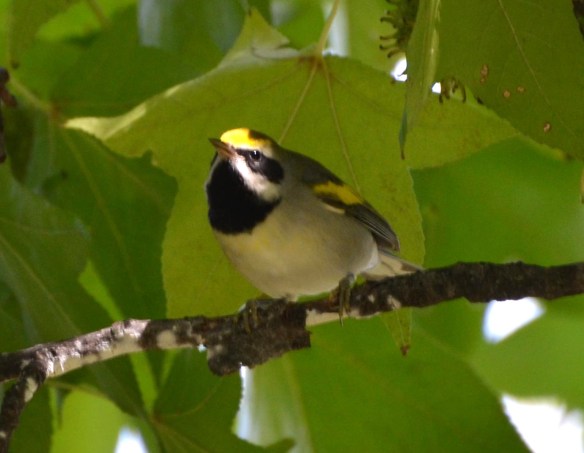
The Elusive Golden-winged Warbler

GWWarbler

Golden-winged Warbler (Wikipedia)

The last section of my book discussed relative warbler rarity in Manhattan. At the time I wrote it, I did not believe that enough eBird data existed to reliably choose which of the 36 regularly-occurring warblers was the rarest (I settled on a top six). Four years later it is safe to say that this title goes to the Golden-winged Warbler.

[This species has suffered a severe decline in population. The Cornell Lab of Ornithology offers an excellent explanation here.]

I was fortunate to see one in September 2012 with many other observers at Strawberry Fields. The bird had been reported there at least twice, beginning in late morning, so it definitely was lingering in the area. Even so, observing it again required two hours of watching and waiting.

I vaguely recall a reliable message-board report of a Golden-winged Warbler at Maintenance in the fall of 2013, but it came much too late — perhaps the following day — to chase it. There also was a text-alert issued for one in the fall of 2014 at the Upper Lobe, which many chased — I was on the scene in ten minutes — but no one found.

Just this last May (2016) Andrew Farnsworth had a Golden-winged Warbler in East Midtown, but the bird was moving through trees so quickly that he was unable to keep it in sight and I abandoned the chase within minutes.

Fast-forward now to this past Saturday, 3 September 2016. At 4:16 p.m. Manhattan Bird Alert (on Twitter) was issued for a Golden-winged Warbler at Maintenance by the fenced-off storage area. I was there in ten minutes, but I saw no birders looking for it — a bad sign. Eventually the man who issued the alert returned, and in conversation I found that the alert actually was issued almost at least a half-hour late because of “technical difficulties” — which is to say an unlikely combination of a yet-earlier finder’s phone running out of power and  the eventual alerter initially sending his alert improperly so it was not re-tweeted.

Give a Golden-winged Warbler a half-hour head start late on a windy day and odds are it will not be found. I searched for two hours, and was later joined by upwards of ten other birders. No one got it. Still, a clear photograph of it perching by the chain fence was later posted on eBird, leaving no doubt that a male Golden-winged had been present earlier.

The very next morning Deborah Allen sent a Manhattan Bird Alert of a Golden-winged Warbler at 8:00 a.m. on the south end of Maintenance. I was in bed and did not see the alert until 8:07. Twenty minutes later I was at Maintenance looking for the bird, which turned out, as I learned from Deborah, to be different from yesterday’s — this time a female.

It was a pleasant, clear Sunday, and many birders searched Maintenance and the surrounding area trying to find the Golden-winged. Again, none succeeded. It appears that there was again a delay (11 minutes) from initial sighting to the time of report. I did not have a good reason to be birding early that morning, as the northeast winds, blowing for a second straight night, were likely to drain the park of birds while doing little to refill it, and that is just how things went. My response to the alert was slow, but another birder already was in the Ramble and chased the alert immediately. He did not get it, either.


Late summer report

Winter birding season really was poor

I complained in my Winter Birding Review that, although I ended the winter with a fine species total (86), I — and nearly everyone else — missed many essential winter birds. Species totals were padded by late-lingering fall birds that would be easy to get in the spring.

Once spring migration was over the effects of this bad winter were more clear. I went into June with only 175 species as compared to the 180 I had then in 2015 and the 182 in 2014 despite having an above-average spring.

Spring migration season was very good

All of the expected birds appeared, and did so in decent numbers, arriving at anticipated times. Arrivals were spread out well, too — unlike in 2014, when migration was delayed by a couple weeks of bad weather before a massive surge concentrated over several days.

Many of the expected but more difficult species were relatively plentiful and easy to observe, with numerous alerts making the job of finding them still more efficient. A female Cape May Warbler, for example, showed up early at the Oven and lingered there for nearly two weeks. Later, Cape Mays gave great, close views in the trees surrounding Turtle Pond, as did Bay-breasted. Yellow-throated Vireo was observed multiple times on many days. A White-eyed Vireo lingered for over a week at the Maintenance Meadow. Both Yellow-billed and Black-billed Cuckoos also made frequent appearances, many of them text-alerted. Mourning Warbler had at least several very chaseable alerts — I ended up seeing it on two occasions.

It was also a fine spring for observing the rarest warblers, which last year did not make much of a showing. Most notably, Kentucky Warbler made a brief but well-followed appearance in the Tupelo Meadow/Maintenance area on the same day (19 May) morning that a Cerulean Warbler lingered near the source of the Gill. Over a month earlier Yellow-throated Warbler showed up in the Maintenance Meadow and re-appeared the following morning. A Prothonotary Warbler was reliably reported on 27 May but was not re-found.

It also was an excellent season for unexpected rarities. I had a close view of Purple Sandpiper on 25 April on the southern tip of Roosevelt Island. Now that this species has been observed there in two consecutive years, perhaps it should be considered a regular visitor? 8 May was a notable day: an American Bittern was found at the Oven and seen by many, as was a Chuck-will’s-widow at Muggers Woods — making 2016 the fourth consecutive year in which the latter has been seen by multitudes in Manhattan. On that same day Andrew Farnsworth had Glossy Ibis over the East River and Golden-winged Warbler near Sutton Place. Let’s also remember the best bird of them all, the Swainson’s Warbler of which I wrote, and not far behind it in terms of rarity, the Seaside Sparrows. It was also a treat to get a clear, close (as opposed to high flyover) view of a male Bobolink in Central Park.

That said, empidonax flycatchers were very rare this year. I had Acadian in the Ramble, and it also was heard on a couple other days. But there were only single reports of Yellow-bellied , Willow, and Alder in Central Park, and I did not have them.

I also missed Blue Grosbeak.  I chased a report of it with Tom Fiore and another birder on the afternoon of 12 May. After Tom and I set out on a different trail, the bird almost immediately reappeared for the third birder who had stayed behind. None of us ended up seeing it again despite hours of search.

Summer has been mildly disappointing

Summer is not over yet, but it has been filled with misses.

I ventured out to the Meer and Turtle Pond at least six times around sunset in June and July in search of another Black Skimmer, but did not see any.

I also made eight trips to the Inwood area in July and August in search of shorebirds and others. All I got out of it were the two most common species I expected to add, Semipalmated Sandpiper and Least Sandpiper.

A juvenile Little Blue Heron on was seen and photographed at Spuyten Duyvil Creek on July 30. Had it been reported immediately, I almost certainly would have been able to reach it in time to observe it, but the finder apparently was not initially sure of the ID. I raced to the scene within an hour of the alert, but by then the tide had risen, the mud had disappeared, and the bird had moved on.

I was, however, delighted to hear a Willow Flycatcher calling on 18 August in the Ramble and  a Red-breasted Nuthatch, also calling,  near Delacorte Theater the following morning.


Bobolink, Central Park Oven

The Bobolink in general is a common bird, but it is a very difficult one to observe in Manhattan. Venture a few miles west, to the New Jersey Meadowlands, or to the coastal marshes of Brooklyn and Queens, and you can find plenty of them during spring and fall migration. You also can observe their migratory flights very early in the morning over Manhattan. Sometimes you can hear their flight calls. Rarely they alight on trees in Central Park in passage, never lingering long before continuing on.

Around 10 a.m. today I encountered AMNH Ornithologist Joseph DiCostanzo and Lenore Swenson in Tupelo Meadow. They told me that they had learned of a male Bobolink in the Oven forty minutes prior, and that they had observed it themselves before it flew off and was not re-found. Joe had attempted to issue an alert on the bird but the email apparently did not go through.

I had come across Bob “Birding Bob” DeCandido and his group earlier and I was birding with them when I got the news. We eventually made our way to the Oven but did not observe the Bobolink. Along the way we had a mystery flycatcher, seen only briefly, and my first-of-season Ruby-throated Hummingbird at Maintenance Meadow.

As a small digression, I should mention that I had a great time birding with Bob. Many know that Bob uses recorded calls and songs to draw in birds, as do many top birding guides. Birds that are perching still sometimes move and reveal themselves; some birds that are out of sight will fly in to check out the commotion; and some that are in sight but high up will descend to levels where they are more easily viewed. The result is that members of Bob’s group see a lot of birds and often get excellent views of them. I certainly had better views than I usually do on my own.

Yesterday, Bob found a Yellow-billed Cuckoo in Tupelo Meadow. I had remained in the Maintenance Meadow, along with many others who were part of a different birding group. Bob ran back to Maintenance to let everyone — not just his group — know of the cuckoo. We enjoyed extended views of the bird flying and foraging high over Tupelo.

Today, after initially striking out at the Oven in search of the Bobolink we moved on to Swampy Pin Oak. Warbler Rock, and the Rustic Shelter, where we saw Indigo Bunting, Great Crested Flycatcher, Eastern Kingbird, and Blackburnian Warbler, among others..

Bob suggested we finish with one more pass over the Oven and then onto the Point. As we we turned onto the dirt path leading to the Point, I began to hear Bobolink song. So did Bob, and he already had the bird in sight, atop a bare tree over the Oven. The Bobolink continued singing loudly, moving around to various high perches both at the Oven and later toward the north to the Captain’s Bench area.

This was my first visual Bobolink in Central Park — I had heard one singing two years ago in the North Woods. What a way to end the morning! With the temperature rising and warblers becoming more scarce, I headed home.


Seaside Sparrow, Hudson Greenway

Thursday, May 5, was cloudy and cold — just like most days this last week. I had taken a walk in the afternoon to the North End as much for exercise as for birding. When I returning home shortly after 4 p.m. I figured I was done for the day.

But at 6:26 p.m. a Manhattan Bird Alert came through from Adrian Burke: he had found three Seaside Sparrows at a small park known as Clinton Cove at 55th and the Hudson Greenway.

My first thought was, “How can I chase these birds?” I live on the Upper East Side, so I would have go entirely across town and then roughly a mile south. I ran across the park to the AMNH subway stop at 81st Street and immediately caught a southbound train to 59th Street. From there I ran to  the location.

Seaside Sparrow is one of the very rarest Ammodramus-type sparrows for Manhattan. There are records on eBird, all in Central Park, from 1923, 1974, and 2011. I had one briefly in October 2014 on Randall’s Island’s northeast saltmarsh, a place you would expect the species, as it gets Nelson’s Sparrows annually.

Where I found Adrian Burke and the sparrows was not at all a place that a Seaside Sparrow should want to be. The three sparrows were moving quickly on foot on a narrow median strip of mostly bare ground and some plants and trees between a paved lane for runners and cyclists and a paved lane for pedestrians.

Walkers, runners, and dogs occasionally scared a sparrow to short flight, but they remained in the area. One ventured onto the eastern edge of a large lawn on the Hudson side.

I was first on the scene, and, along with a couple others who showed up, got great views from less than ten feet. The sparrows appeared not to mind our presence as they went about their foraging.

These sparrows went on to defy expectations by remaining at this location during both the following day and the day after that — today, May 7.

Another Seaside Sparrow was found at 65th and the Hudson Greenway on the morning of May 6. It, too, has remained in place since then. A fourth Seaside Sparrow appeared at the Clinton Cove location, also on May 6. An American Kestrel was observed catching and carrying away one of the Clinton Cove sparrows that same day.


Swainson’s Warbler, Strawberry Fields

Last night’s winds looked unfavorable for birding this morning. For the first few hours after sundown they were light and southwesterly, encouraging Central Park migrants to fly out. Later they switched to northwesterly, discouraging flight into the park. So I did not intend to do any early birding, and temperatures in the low 50s only strengthened the case for waiting.

After seeing #birdcp Twitter reports before 7 a.m., I knew that some good birds probably had remained in the park — Nashville and Worm-eating Warbler, for example. But I had already observed these in recent days and had no interest in chasing them.

As I was having breakfast a 7:22 a.m.a Twitter alert arrived, issued by Alice Deutsch, one of the park’s most expert and well-traveled birders: “Swainson’s Warbler, Imagine mosaic.” My first thought was that she meant Swainson’s Thrush, a common bird but one that would be early and first-of-season for Central Park, so worth reporting. But a few minutes later she tweeted, “Confirming, and it’s singing.” It had to be a Swainson’s Warbler, just as she had written — she would not bother confirming a common thrush, nor would anyone care that one was singing.

This meant I had to get to Strawberry Fields — fast! No time to finish eating. I put on running clothes, packed my bag, and I was out the door.

At 7:46 I arrived at the mosaic to see 25+ birders looking into the shrubs to the south. Almost immediately the Swainson’s Warbler sang and then popped up to perch on some foliage several feet off the ground. Then it flew another 5o feet south, landing in a tree, where it continued singing but was not being seen. Soon it was found on the ground, inside and underneath the dense shrubs. This is where it stayed during the time I viewed it (as late as 9:35 a.m.) and, I am told, the remainder of the day.

Within 90 minutes over 150 people had stopped by to see this rarity. It has been recorded only four times in Central Park with multiple observers (each time in May, in 1973, 1979, 1990, and 2000). A very reliable single observer had it at the Upper Lobe, briefly, in May 2012.