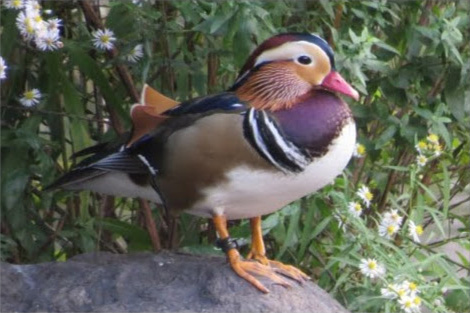
Mandarin Duck Mania, Central Park

MandarinGusKeri

Mandarin Duck by Gus Keri

Last week a certain duck became a media sensation, and I was taken along for the ride. Gus Keri’s video of the male Mandarin Duck at the Central Park Pond, posted on my Manhattan Bird Alert Twitter account,  had already gone viral over two weeks prior, when the duck first appeared there on October 10.

Jen Carlson of Gothamist interviewed me and wrote the story that introduced the broader New York world to the mysterious Mandarin Duck. Then the duck frustrated everyone by disappearing two weeks. I thought he had been eaten by a raptor.

But on October 25 we learned that the Mandarin Duck lived on, seen at the 79th Street Boat Basin on the Hudson. By Sunday, October 28, the Mandarin Duck had returned to the Central Park Pond.

Julia Jacobs of the New York Times met with me to view the duck on October 30, and her brilliant story was published early the next morning. It quickly became the most popular story on the New York Times website and was liked tens of thousands of times on Twitter.

Since then, I have been doing a great many interviews with reporters from news organizations all over the world about the Mandarin Duck, which continued to draw hundreds of admirers to the Central Park Pond this last weekend hoping to see and, better yet, take a photo or video of the vibrantly-colored bird.

Many are finding joy in observing the Mandarin Duck, and I am delighted that my alerts account has been able to help them locate him and display their footage.

Let’s be clear: this Mandarin Duck is of domestic origin. He is not a wild bird, and he certainly is not ABA-countable or eligible for the eBird database.

Right now, though, he is New York City’s most famous duck, and we are glad to have him.
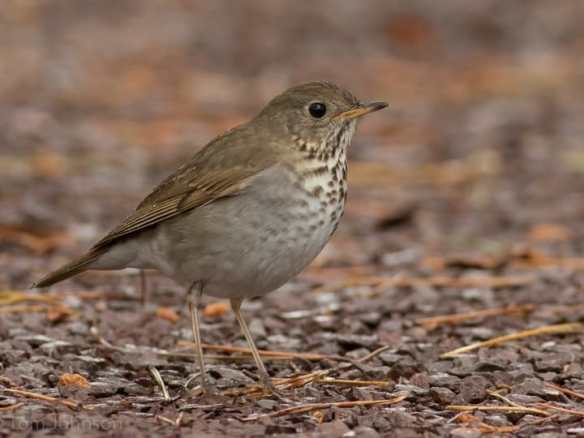
 

Bicknell’s Thrush, Central Park Ramble

Bicknell’s Thrush (from allaboutbirds.org)

This morning Roger Pasquier heard the song of a Bicknell’s Thrush at Evodia (the Ramble bird feeder area). He later told Anthony Collerton about it and pointed out the bird, a warm-toned thrush associating closely with a grayer Gray-cheeked Thrush. Collerton issued a Manhattan Bird Alert (follow @BirdCentralPark on Twitter) to let everyone know. He himself had not heard the bird sing.

I arrived at Evodia some minutes later, after Collerton had left, and quickly found a pair of thrushes on the east side of Evodia that matched the stated description. I announced my find to other birders nearby just as the bird was flying to the west side of Evodia.

As I have written before, visual identification is not sufficient to claim a Bicknell’s Thrush, as Gray-cheeked can look much the same. One needs to hear the Bicknell’s song, which ends with a thin, rising pitch.

Both thrushes were staying silent and had wandered out of view. When we started playing the Bicknell’s song on a mobile phone, one of the thrushes came back into view and perched overhead, calling “whee-er”. Soon it flew down and sang. We had our Bicknell’s!

Shortly thereafter I called it in again for Anders Peltomaa and Al “Big Year” Levantin and elicited singing in response. Same later for Joseph DiCostanzo and his American Museum of Natural History walk.

I also heard the Bicknell’s Thrush sing on its own, unprompted, just east of the Gill Source at 10:18 a.m.

A half-hour later Robert DeCandido came by Evodia and helped members of his birding walk see and hear a singing Bicknell’s Thrush.

American Bird Conservancy President Mike Parr and his group were nearby at the time and might have heard the Bicknell’s song. To be sure, I used my phone to call it back again and everyone got close views of the calling and singing  bird.

Bicknell’s Thrush remains a rarity not just in Central Park but throughout its tight migration range along the East Coast. Since identification requires hearing its song, it is possible to get it only during spring migration. Even then, the time window seems to be narrow — I have never had Bicknell’s on more than one day in any May, and there are usually at most only a few days in any May when I hear much thrush song in Central Park. The possible date range for it here seems to be May 12 to May 25, judging by historical Central Park records and my own experience.